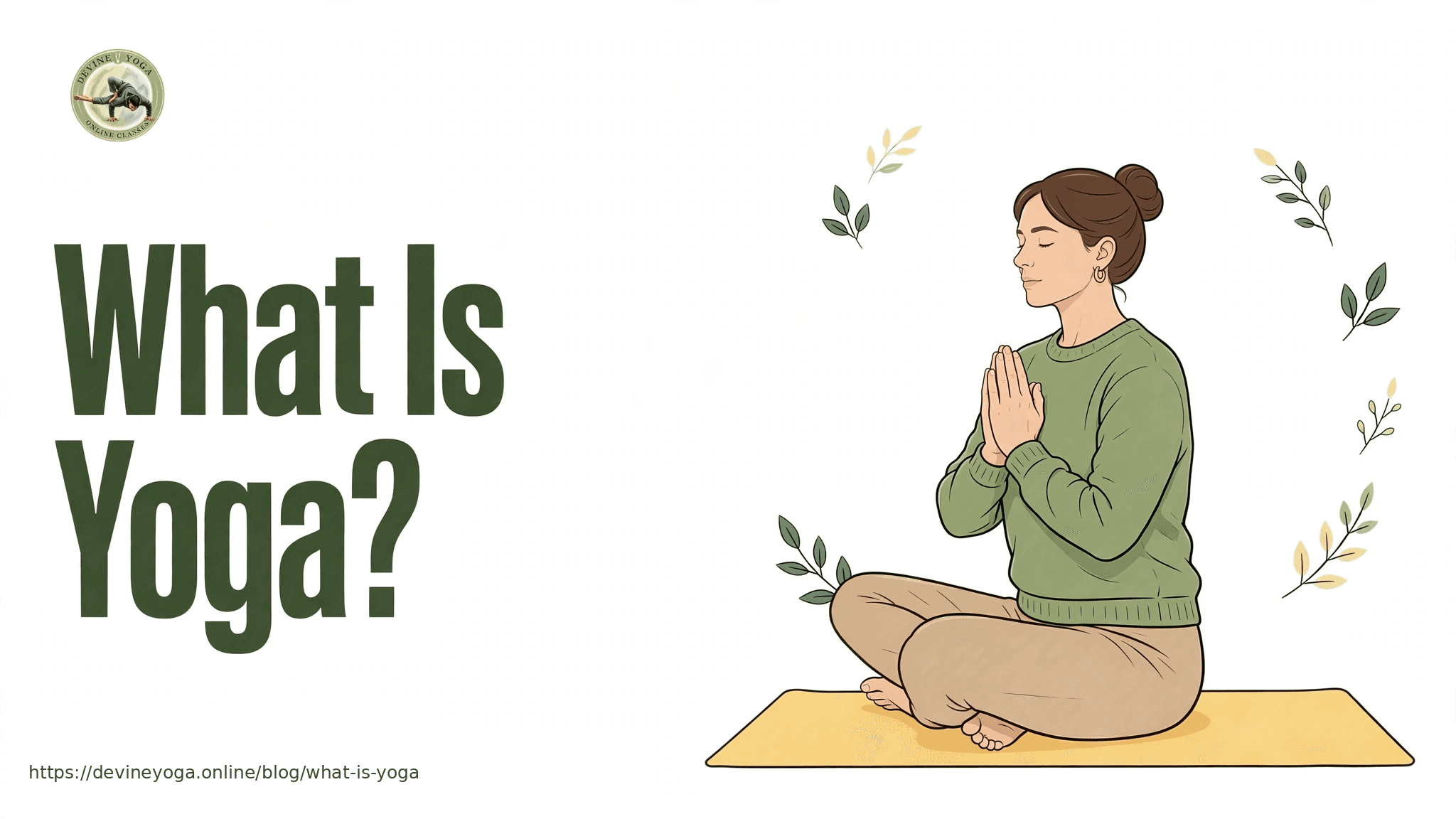
What Is Yoga?
Curious about yoga? Explore its meaning, history, different practices, benefits, and beginner-friendly ways to start practicing safely.
Summarize this blog with:
What Is Yoga?
Yoga is an ancient Indian discipline that brings together physical postures, breathing practices, concentration, and meditation to support overall well-being. The word yoga comes from the Sanskrit root yuj, often understood as “to join” or “to unite.” Today, yoga can be practiced as a physical exercise, a mindfulness practice, or a broader lifestyle rooted in self-awareness and balance.
Yoga is much more than stretching or becoming flexible. It is a holistic practice that can help you develop strength, mobility, body awareness, breathing control, concentration, and calmness.
In this guide, we’ll look at what yoga really means, where it comes from, its main practices, and how beginners can start safely.
Where Did Yoga Come From?
Yoga has its roots in the Indian subcontinent and has developed over thousands of years through different philosophical and spiritual traditions. It is not the creation of a single teacher or a single historical period.
Early ideas related to yoga appear in ancient Indian texts, while later traditions developed more systematic approaches to meditation, self-discipline, physical practices, and breathwork.
The Yoga Sutras of Patanjali, traditionally attributed to Patanjali, are one of the best-known classical sources associated with yoga philosophy. The text presents an eight-limbed path that includes ethical principles, personal observances, posture, breath regulation, withdrawal of the senses, concentration, meditation, and samadhi.
Later Hatha Yoga traditions placed greater emphasis on practices involving the body and breath. The Hatha Yoga Pradipika, a medieval text, is one of the important sources associated with this tradition.
Modern yoga has developed in many different directions, giving rise to many different styles of yoga. Some contemporary classes emphasize physical movement and fitness, while others place greater emphasis on meditation, breathing, relaxation, philosophy, or a combination of these practices.
What Are the Main Parts of Yoga?
Yoga has several interconnected practices, and understanding them helps explain why yoga cannot be reduced to stretching.
Asana: Physical Postures
Asana refers to physical postures used in yoga practice.
Examples include:
- Tadasana - Mountain Pose
- Adho Mukha Svanasana - Downward-Facing Dog
- Bhujangasana - Cobra Pose
- Balasana - Child's Pose
- Trikonasana - Triangle Pose
- Setu Bandhasana - Bridge Pose
The goal of an Asana practice is not simply to make a pose look impressive.
Good practice involves appropriate alignment, controlled movement, breathing, and awareness of your body's current abilities.
Pranayama: Breath Practices
Pranayama is the conscious regulation of breathing.
Traditional yoga contains many different pranayama techniques. Depending on the method, practice may involve changing breathing rhythm, duration, or awareness.
Beginners should learn breathing techniques gradually and avoid forcing the breath or holding it for long periods without appropriate instruction.
Dhyana: Meditation
Dhyana means meditation or sustained contemplative attention.
Rather than constantly reacting to thoughts, meditation encourages a practitioner to observe mental activity and develop steadier attention.
Even a few quiet minutes can introduce beginners to this aspect of yoga.
Dharana: Concentration
Dharana refers to focused concentration.
A practitioner may focus attention on the breath, a mantra, an object, or another chosen point of attention.
This practice is closely related to meditation but emphasizes maintaining focused attention.
Is Yoga Just Exercise?
No. Yoga includes physical exercise, but yoga is broader than exercise alone. Traditional yoga incorporates physical practices alongside breath regulation, concentration, meditation, ethical principles, and self-discipline.
A yoga class may include several different elements:
- Asana - physical postures
- Pranayama - conscious regulation of the breath
- Dhyana - meditation
- Dharana - concentration
- Savasana - a resting posture traditionally used at the end of practice
- Yama and Niyama - ethical and personal disciplines described in classical yoga
A modern beginner class does not necessarily include all of these components. Different yoga styles and teachers emphasize different parts of the tradition.
For example, Hatha Yoga classes may focus strongly on physical postures, breathing, and mindful practice, while meditation-focused traditions may place greater emphasis on mental concentration.
How Do I Start Practicing Yoga?
Start with 15 to 20 minutes, two or three times a week, using simple poses and slow breathing. Here is a gentle starter sequence:
- Easy Pose (Sukhasana), 1 minute. Sit tall on a folded blanket so your hips sit above your knees. Breathe in and out through the nose.
- Cat-Cow (Marjaryasana-Bitilasana), 8 to 10 breaths. Hands under shoulders, knees under hips. Move your spine slowly with your breath.
- Mountain Pose (Tadasana), 5 breaths. Stand with feet hip-width apart, weight even, shoulders relaxed.
- Child’s Pose (Balasana), 1 minute. Knees wide, big toes touching, forehead down. If your knees feel strained, place a folded blanket behind them.
- Corpse Pose (Savasana), 3 to 5 minutes. Lie on your back, let your body feel heavy and breathe naturally.
Prefer a trainer to correct your poses? Try a free 3-day live trial.
When Should You Avoid Yoga?
Yoga can be adapted for many people, but it is not appropriate to push through every situation. If you have an injury, severe pain, certain medical conditions, or are recovering from surgery, you may need to avoid specific poses or temporarily stop physical yoga until you receive appropriate medical guidance.
You should be particularly careful in the following situations:
1. When You Have an Acute Injury
Avoid practicing through sharp or sudden pain. An injury involving the back, neck, shoulder, knee, wrist, or another joint may require rest, rehabilitation, or modified movement.
If you are recovering from an injury, ask your doctor or physiotherapist which movements are appropriate before returning to yoga.
2. After Surgery
Your body may need time to heal after surgery. Even gentle-looking yoga poses can place stress on healing tissues.
Do not return to your usual yoga routine until your healthcare professional confirms that physical activity is appropriate and explains any necessary restrictions.
3. During Pregnancy Without Appropriate Guidance
Yoga may be suitable during pregnancy for many people, but not every pose or breathing technique is appropriate at every stage.
Pregnant practitioners should choose pregnancy-appropriate classes and inform their yoga teacher. If there are pregnancy complications or other medical concerns, consult your healthcare professional before exercising.
4. If You Experience Severe Pain
Yoga should not be used to “push through” severe pain.
A mild stretching sensation can occur during some movements, but sharp, intense, or persistent pain is a reason to stop the movement. If pain continues or is significant, seek appropriate medical advice.
5. If You Feel Dizzy, Faint, or Unwell
Stop your practice if you experience dizziness, fainting, unusual shortness of breath, chest pain, or significant weakness.
Sit or lie down somewhere safe and seek medical attention when appropriate, particularly if symptoms are severe, sudden, or unusual for you.
6. With Certain Medical Conditions
People with cardiovascular conditions, uncontrolled blood pressure, significant balance problems, osteoporosis, neurological conditions, or other health concerns may need specific modifications.
This does not necessarily mean you cannot practice yoga. It means your practice should be adapted to your individual circumstances with guidance from an appropriate healthcare professional and, where needed, a qualified yoga teacher.
7. Before Advanced Yoga Practices
Beginners should not immediately attempt advanced inversions, deep backbends, intense arm balances, or forceful breathing techniques simply because they look impressive.
These practices can place considerable demands on the body and require appropriate preparation and instruction. To see why some postures are so demanding, read about the hardest yoga poses before you try them.
Frequently asked questions
What is yoga in simple words?
Yoga is a practice that connects body, breath and mind through postures, breathing exercises and meditation. It began in ancient India and is now practiced worldwide to improve strength, flexibility, focus and calm. You don’t need to be flexible to start.
How often should a beginner do yoga?
Start with 2-3 times per week for 20-30 minutes. This allows your body to recover and builds a habit. Short daily practice, even 10 minutes of breathwork and gentle stretching, is very effective.
Is yoga only exercise?
No. Physical postures (asana) are just one of yoga’s eight limbs. Yoga also includes ethical principles, breathing techniques, concentration and meditation. Many people use it mainly as exercise, but its original aim was mental clarity and inner steadiness.
What is the difference between yoga and exercise?
Exercise often focuses only on the physical body. Yoga integrates physical postures (asana), breathing techniques (pranayama), and meditation (dhyana) to work on physical, mental, and emotional well-being simultaneously.
How long does it take to see benefits from yoga?
Many students report feeling calmer and sleeping better after just 1-2 weeks of consistent practice. Flexibility and strength improvements typically become noticeable after 4-8 weeks of regular practice, 3 times per week.
Reading is a start. A live teacher is the shortcut.
In a Devine Yoga Online class your trainer sees you, corrects you by name and adapts every pose to your body - beginners included.
Related blogs
Pranayama: Types, Benefits and How to Do Them
What is Pranayama? Learn 8 types of pranayama, benefits, correct steps, ratios & precautions. Complete beginner guide from Devine Yoga.
11 min read
Group vs Personal Online Yoga
Group or personal online yoga? Compare cost, attention, safety and flexibility to choose the right fit for your goals.
11 min read
Yoga Mistakes Beginners Make
Discover the most common yoga mistakes beginners make and learn simple, practical fixes to improve your alignment, breathe better, and practise safely.
8 min read