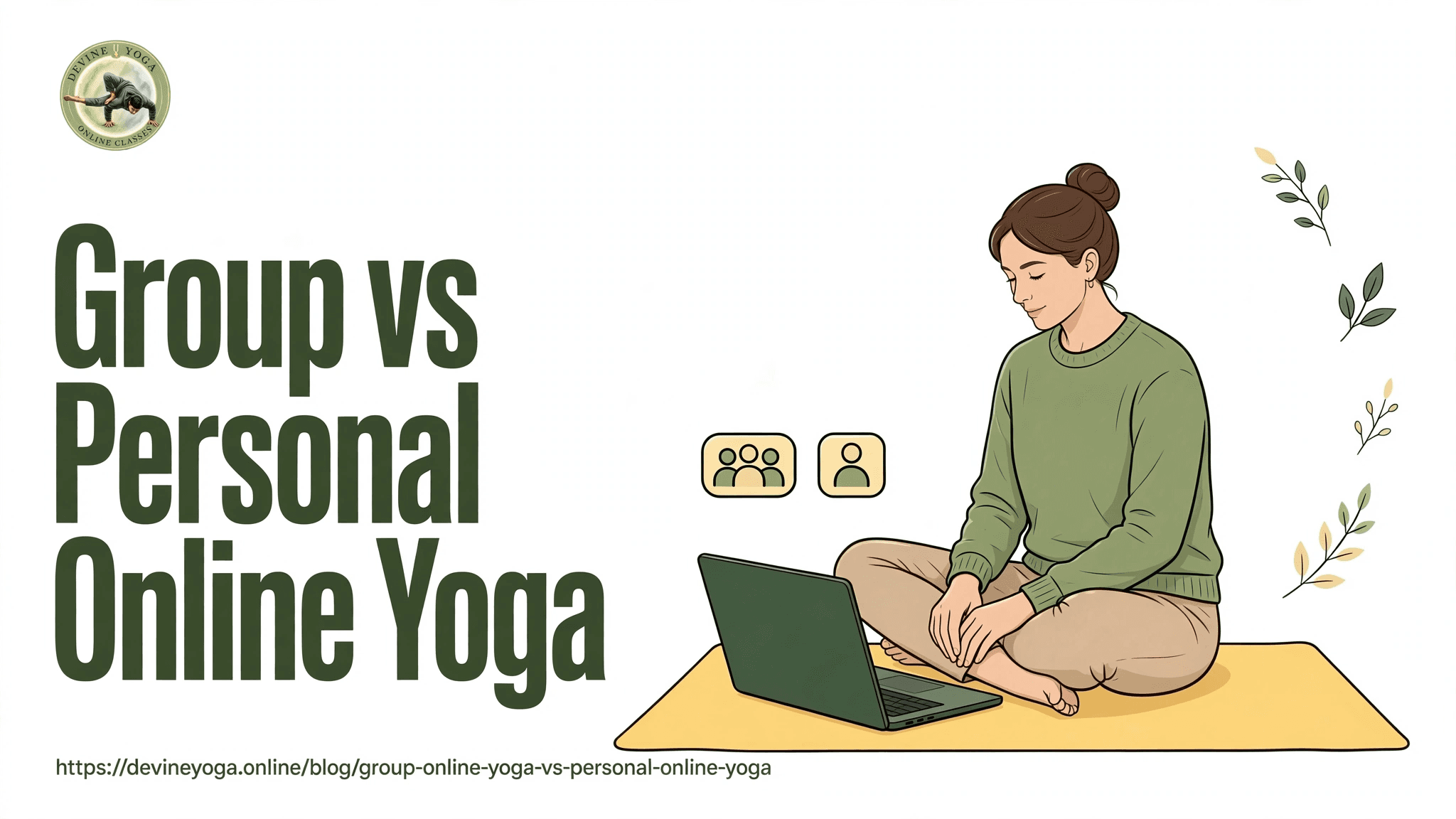
Group vs Personal Online Yoga
Group or personal online yoga? Compare cost, attention, safety and flexibility to choose the right fit for your goals.
Summarize this blog with:
What is group online yoga?
Group online yoga is a yoga class led by one teacher for several students at the same time, usually over a video call, at a fixed schedule. Class sizes vary from around 5 to 6 students in a small group to 30 or more in a larger session. Some groups are live, while others are pre-recorded and available on demand.
A typical group class follows a set structure: a short opening and breath awareness, a sequence of postures (asanas), a cool-down, and a closing relaxation in Savasana. The teacher leads the whole class at one pace and offers general options, such as “if this is too intense, lower your knees.”
There are three common formats:
- Live group classes: The teacher and students are on video together at a fixed time. You can ask questions and receive some feedback.
- Small-batch classes: Limited to a small number of students (for example, 4 to 8), so the teacher can see everyone and correct individuals.
- Recorded or on-demand classes: You follow a video at your own time. This is the most flexible but offers no real-time feedback.
What is personal online yoga?
Personal online yoga is a one-to-one session in which the teacher builds the entire class around your body, health, goals and pace. It is also called private yoga, one-on-one yoga or personal yoga coaching.
Before the first session, a good teacher will ask about your experience, injuries, medical history, daily routine and what you hope to achieve. Every class after that is shaped by your answers. The teacher watches your alignment on camera, corrects you in real time, adjusts the pace to your breathing and changes the sequence if something doesn’t feel right.
Personal sessions can be:
- A single session to learn a specific practice, such as a morning routine or a pranayama technique
- A short program (for example, 4 to 8 weeks) around a goal, such as flexibility, back care or stress management
- Ongoing weekly coaching with regular progress reviews
Group vs Personal Online Yoga: Detailed Comparison
The main difference between group and personal online yoga is personalization vs community. Personal online yoga offers faster, safer results for specific needs, while group online yoga offers affordability, routine, and peer motivation.
Here is the exact comparison I give to new students during their free trial consultation at Devine Yoga Online:
| Factor | Group Online Yoga | Personal Online Yoga |
|---|---|---|
| What It Is | 1 teacher : 8-25 students live | 1 teacher : 1 student live |
| Personalization | Low - general sequence for all | High - fully customized for your body & goal |
| Correction & Safety | General cues, limited individual check | Constant, detailed alignment correction |
| Best For | Motivation, habit, general wellness, budget | Beginners, injuries, back pain, specific goals, faster results |
| Cost in India | Rs 1,200 - Rs 2,500 / month | Rs 4,000 - Rs 10,000 / month (8-12 classes) |
| Cost Global | $20 - $50 / month | $120 - $300 / month |
| Schedule Flexibility | Fixed - need to join on time | Very flexible - you choose time, reschedule |
| Motivation | High - group energy pushes you to show up | Medium - needs self-discipline, but teacher accountability is high |
| Privacy | Low - others see you (can off camera) | High - you can share health issues freely |
| Progress Tracking | General - you track yourself | Detailed - teacher maintains notes, assessments, progress photos |
| Result Speed | Slow to moderate - general progress | Fast - 3x faster for specific goals like flexibility or pain relief |
Which Is Better for Beginners?
For complete beginners, personal online yoga is safer and better for the first 4-8 weeks, then you can shift to group online yoga for consistency.
Here’s why I say this from experience:
When you are new, you don’t know the difference between Tadasana and just standing, or between a correct Downward Dog and one that hurts your wrists. In a group class of 20, I can give you maybe 30 seconds of personal attention.
In a personal class, I spend 10 minutes just teaching you how to breathe into your belly and align your feet.
My Recommendation at Devine Yoga Online:
Choose Personal Online Yoga first if you are:
- A complete beginner who has never done yoga
- Stiff, overweight, or very inflexible
- Have any injury - back pain, knee pain, frozen shoulder, PCOS/PCOD, prenatal
- Shy or self-conscious about body or flexibility
- Want to learn correct technique from day one
Choose Group Online Yoga first if you are:
- You already know basic poses and want regularity
- You love community energy and feel motivated seeing others
- Your goal is general wellness, stress relief, not a specific medical issue
- Budget is a major constraint
In fact, 70% of our long-term students at Devine Yoga Online start with 1 month of personal classes, then move to group classes for maintenance. That hybrid model works best.
What are the advantages of group online yoga?
The biggest advantages of group online yoga are affordability, routine, motivation and the sense of community.
1. It costs less. The teacher’s time is shared among students, so the fee per person is lower. This makes it easier to practice several times a week.
2. It builds a routine. A fixed class time creates a commitment. Many students find they practice more consistently because the class is in their calendar and a teacher is expecting them.
3. The group energy helps. Practicing alongside others, even on a screen, can make it easier to show up on low-energy days. Many people feel supported by seeing others at different levels.
4. You see different bodies and levels. Watching others use blocks, bend their knees or skip a pose reminds you that modifications are normal, not a sign of weakness.
5. It is a lower-pressure way to try yoga. You can turn your camera off in most live classes if you prefer, and nobody is watching only you.
6. You can try different styles and teachers. Group schedules often include Hatha, Vinyasa, Yin and restorative sessions, so you can explore what suits you.
What are the limitations of group online yoga?
The main limitations are limited individual attention, less customization and a fixed pace. These matter most for beginners with physical concerns.
- The teacher can’t watch everyone closely. On a screen, the teacher sees small squares of students. In a large class, subtle alignment problems, such as a collapsed lower back in a forward fold or a strained neck, can go unnoticed.
- The pace isn’t yours. If the class moves on before you’re ready, you may rush, hold your breath or skip the pose. If the pace is too slow for you, you may lose interest.
- Modifications are general. A teacher might offer a few options, but those won’t always suit your specific injury or condition.
- Fixed schedules can clash with real life. If you miss a class, you miss it, unless recordings are available.
- Technical issues can disrupt the flow. Weak internet, a poorly placed camera or noisy surroundings can affect the experience.
- Comparison can creep in. Some students feel pressure to keep up with others, which raises the risk of pushing too far.
None of these is a dealbreaker for a healthy beginner with a good teacher. But they are the reasons some people move to personal sessions.
What are the advantages of personal online yoga?
The biggest advantages of personal online yoga are tailored guidance, safer progress and flexibility.
1. The class is designed for you. Your teacher plans the sequence around your flexibility, strength, injuries and goals. A desk worker with tight hips and a stiff upper back gets a different class from someone recovering from a sports strain.
2. You get real-time corrections. The teacher can pause, adjust your camera angle, and fix your alignment cue by cue. Small corrections early on help build safe habits.
3. It adapts to health considerations. Your teacher can plan around conditions such as back pain, knee issues, high blood pressure, pregnancy (with medical approval) or stress-related fatigue, and can avoid or modify risky poses. This does not replace medical advice, but it makes the practice more thoughtful.
4. You progress at your own speed. There’s no waiting for others and no rushing. Breath practices (pranayama) in particular benefit from one-to-one pacing, since the teacher can watch your posture and listen to your breathing.
5. It’s flexible. You and the teacher can agree on times that fit your life, and sessions can be rescheduled more easily.
6. It is private. Students who feel shy, self-conscious or anxious in groups often relax more fully in a one-to-one setting.
7. It gives you a clear plan. A personal teacher can set milestones, such as touching your toes comfortably, holding a pose for a minute or building a 20-minute daily routine, and help you track progress.
What are the limitations of personal online yoga?
The main limitations are higher cost, less community and the risk of depending too much on the teacher.
- It costs more per session. You are paying for one teacher’s full attention. For regular practice, this can add up, so check the cost comparison in the table above and decide how many personal sessions fit your budget.
- There’s no group energy. Some students miss the shared atmosphere and find it harder to stay motivated alone.
- It can create dependence. If you only practice during sessions, you may not build the habit of practicing independently. A good teacher will gradually prepare you to practice on your own.
- Quality varies. Because the teacher’s expertise is the whole offering, a poor match matters more. It’s worth checking credentials and trying an intro session.
- You see fewer examples. You won’t see how other students use props or modifications.
Which format gives better results?
Neither format guarantees results. Consistent, safe practice with a qualified teacher is what matters most. Research on yoga generally supports modest benefits for areas such as stress, wellbeing and low back pain, but studies typically look at yoga overall, not at group versus one-to-one delivery. So there’s no solid evidence that one format is universally better.
In practice, results depend on:
- Consistency: Group classes help some people show up regularly, while others stay consistent with a personal teacher who tracks their progress.
- Quality of guidance: Clear instruction, safe alignment and appropriate progression matter more than format.
- Fit with your goal: General fitness and relaxation suit group classes. Specific goals, such as relieving stiffness from desk work or learning proper pranayama, benefit from personal attention.
- Home practice: The more you practice between classes, the faster you progress in either format.
How do you choose between group and personal online yoga?
Choose based on your health, goal, budget and personality, then try one trial class before committing. Use these questions as a quick decision guide.
- Do you have any injury, medical condition or pregnancy? If yes, start with a personal session, or at least speak to the teacher first.
- Are you a complete beginner who is nervous about technique? Personal sessions for the first 2 to 4 weeks can build confidence.
- Is your budget limited? Start with group classes and add a personal session now and then.
- Do you struggle to stay motivated alone? A group schedule can help.
- Is your schedule unpredictable? Personal sessions or recorded classes offer more flexibility.
- Do you have a specific goal? (For example, a daily pranayama habit, back care, or stress relief.) Personal guidance can help you reach it more directly.
- Do you enjoy social energy? Group classes may suit you better.
Can you combine group and personal online yoga?
Yes. Many students get the best results by combining the two. A hybrid approach gives you the affordability and community of group classes plus the correction and customization of personal sessions.
Some popular combinations:
- Start personal, then switch to group. Take 3 to 4 personal sessions to learn safe alignment and your own limits, then join group classes with confidence.
- Mostly group, with a monthly personal check-in. Your teacher reviews your progress, fixes any habits and updates your goals.
- Group for movement, personal for breathwork. Pranayama and meditation are often easier to learn one-to-one, while postures work well in groups.
- Personal during a flare-up or recovery. Return to group classes when you’re ready.
Frequently asked questions
What is group online yoga?
A live or recorded class where one teacher guides several students at once. It is affordable, follows a fixed schedule and offers a sense of community.
What is personal online yoga?
A one-to-one session where the teacher plans the whole class around your body, goals and pace. You get full attention and real-time corrections.
Which is better for beginners?
Healthy beginners can start with a group class. If you have an injury, a health condition or feel nervous about technique, a few personal sessions first are safer.
Is personal online yoga worth the cost?
Yes, if you need tailored guidance or have specific concerns. A few sessions can teach you a safe routine to practice alone.
Is online group yoga safe?
It is generally safe for healthy people with a qualified teacher and a beginner-level class. Tell the teacher about any injuries beforehand and stop if anything hurts.
Which is cheaper, group or personal online yoga?
Group classes cost less per session because the teacher's time is shared. Personal sessions cost more but are more focused.
Can I switch between group and personal online yoga?
Yes. Many students start personal and move to group, or attend group classes with occasional personal check-ins.
How big should an online yoga group be?
Smaller groups of about 4 to 10 students let the teacher see everyone and give corrections. Larger groups offer less individual feedback.
Are recorded classes as good as live ones?
Recorded classes are flexible and affordable but give no real-time feedback. Beginners learn better in live classes.
Which one is right for me?
Choose group for budget, routine and community. Choose personal for injuries, specific goals or privacy. A hybrid often works best.
Reading is a start. A live teacher is the shortcut.
In a Devine Yoga Online class your trainer sees you, corrects you by name and adapts every pose to your body - beginners included.
Related blogs
Online Yoga for Weight Loss: Beginner's Guide
Learn how online yoga can support weight loss, which styles to try, and how to build a realistic beginner yoga plan at home.
8 min read
Devine Yoga Online vs Habuild
Devine Yoga Online vs Habuild: compare free live trial, batch size, trainer attention, student dashboard and pricing to pick the right online yoga class.
8 min read

Pranayama: Types, Benefits and How to Do Them
What is Pranayama? Learn 8 types of pranayama, benefits, correct steps, ratios & precautions. Complete beginner guide from Devine Yoga.
11 min read