Hatha Yoga for Beginners
Learn the basics of Hatha yoga with our beginner-friendly guide. Master gentle poses, improve flexibility, and start your calming practice at home today.

What Is Hatha Yoga?
Hatha Yoga is a broad tradition of yoga that incorporates physical postures, breathing techniques, concentration, and other practices designed to develop balance between the body and mind.
The word "Hatha" is traditionally associated with the concepts of "ha" and "tha", often interpreted as complementary energies such as sun and moon. However, the historical development of Hatha Yoga is more complex than this simple interpretation.
Traditional Hatha Yoga developed through a variety of practices and texts over many centuries. Modern Hatha Yoga classes can differ considerably depending on the teacher, school, and approach.
In many modern classes, Hatha Yoga involves:
- Yoga postures (asanas)
- Breathing exercises (pranayama)
- Relaxation
- Concentration or meditation
- Mindful movement
- Body awareness
A typical class may move at a relatively steady pace, allowing students time to understand alignment, breathing, and the sensations associated with each posture.
What Are the Benefits of Hatha Yoga?
Regular yoga practice may support several aspects of physical and mental well-being. Research on yoga has associated regular practice with improvements in areas such as flexibility, balance, strength, stress management, and overall well-being.
However, individual results can vary depending on factors such as consistency, the style of yoga practised, physical condition, and other lifestyle factors.
1. Improves Flexibility
Many Hatha Yoga postures involve controlled stretching of different muscle groups.
With consistent practice, yoga may help improve flexibility and range of motion. Beginners do not need to be flexible before starting. Flexibility can gradually develop as the body becomes accustomed to regular movement.
2. Builds Strength
Hatha Yoga is not only about stretching.
Postures such as plank, Chair Pose, Warrior variations, and Boat Pose can require the muscles to support and stabilize the body.
Holding a posture with proper technique can help develop functional strength and muscular endurance.
3. Supports Better Balance
Many Hatha Yoga poses challenge your ability to maintain stability and body awareness.
Balancing postures can encourage you to pay attention to your feet, posture, breathing, and the position of different parts of your body.
Regular practice may therefore support physical balance and coordination.
4. Encourages Better Body Awareness
One of the important aspects of yoga is learning to notice how your body feels.
During a Hatha Yoga session, you may become more aware of:
- Muscle tension
- Breathing patterns
- Posture
- Balance
- Movement limitations
- Physical sensations
This awareness can help you practise more mindfully and recognise when you need to modify a movement.
5. May Help Manage Stress
Yoga combines physical movement with breathing and focused attention.
This combination can provide a structured opportunity to slow down and focus on the present moment. Research has found associations between yoga practice and improvements in stress and psychological well-being.
Hatha yoga can therefore be a useful addition to a broader stress-management routine.
6. Supports Relaxation
A Hatha Yoga session often ends with a relaxation period, such as Savasana.
Slowing down after physical movement can give you an opportunity to release tension, observe your breathing, and transition into a more relaxed state.
7. Develops Mindfulness
Hatha Yoga encourages you to pay attention to your body and breath rather than simply moving through exercises.
This focus can make your practice more mindful and may help you develop greater awareness of how your body responds to movement and stress.
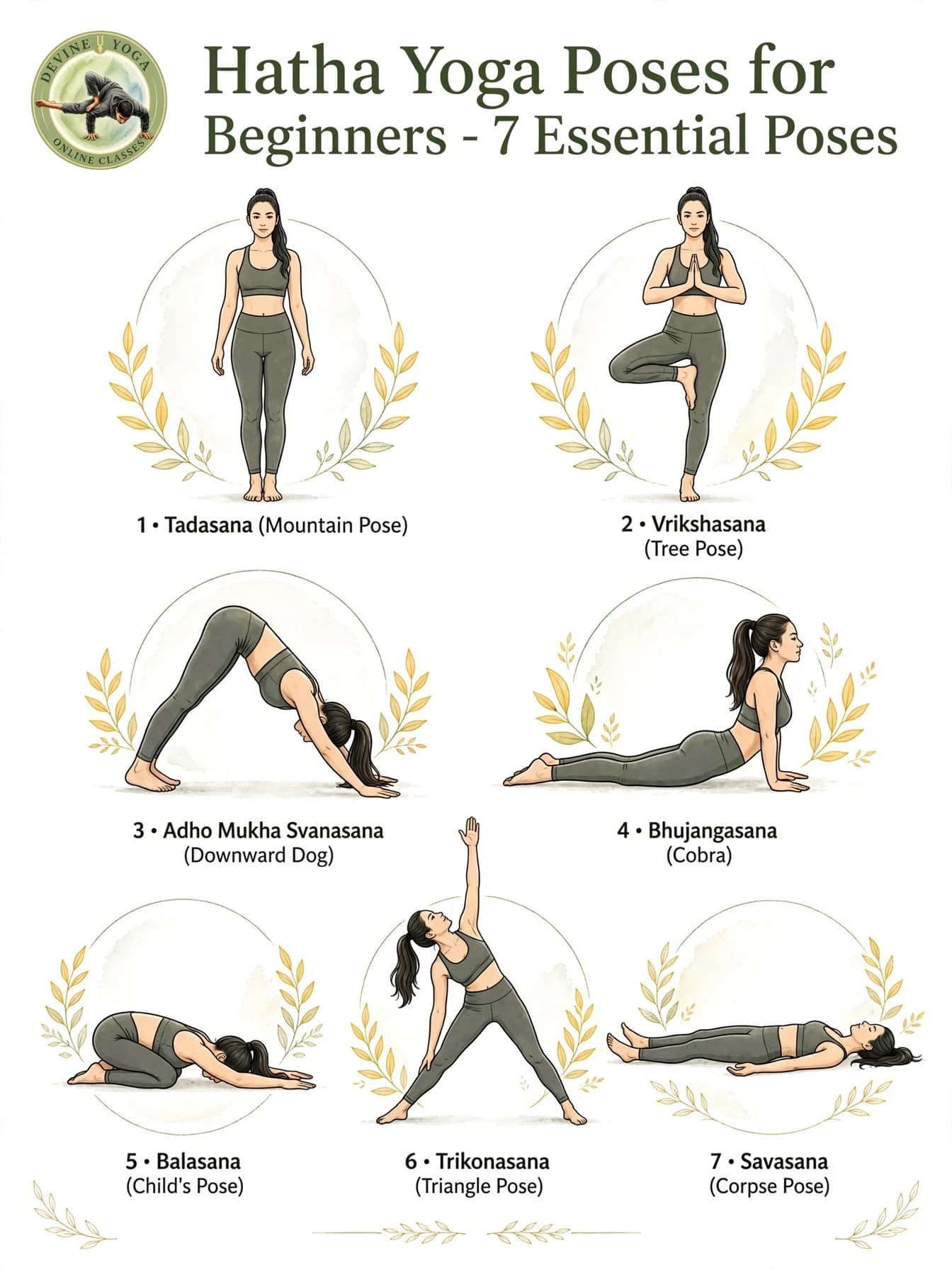
Hatha Yoga Poses for Beginners
You do not need to master advanced yoga poses to begin practicing Hatha Yoga.
Here are several common poses that can be incorporated into a beginner-friendly practice.
1. Mountain Pose (Tadasana)
Mountain Pose is a foundational standing posture.
Stand upright with your feet grounded and your spine naturally lengthened. Relax your shoulders and maintain steady breathing.
Potential benefits:
- Encourages awareness of standing posture
- Develops body alignment awareness
- Creates a foundation for standing poses
2. Child's Pose (Balasana)
Child's Pose is commonly used as a resting posture.
From a kneeling position, gently lower your torso toward the floor and allow your arms to rest comfortably.
Potential benefits:
- Provides a gentle resting position
- Encourages relaxation
- Allows you to reconnect with your breathing
3. Cat-Cow Pose (Marjaryasana-Bitilasana)
Cat-Cow involves moving between two positions while coordinating movement with breathing.
It is often used during warm-ups.
Potential benefits:
- Encourages gentle spinal movement
- Helps warm up the body
- Develops movement and breathing coordination
4. Downward-Facing Dog (Adho Mukha Svanasana)
Downward-Facing Dog is a commonly practiced yoga posture involving the shoulders, arms, legs, and back.
Beginners can modify the pose according to their mobility and comfort.
Potential benefits:
- Works multiple muscle groups
- Encourages shoulder and hip mobility
- Develops strength and body awareness
5. Warrior II (Virabhadrasana II)
Warrior II is a standing posture that requires strength, stability, and concentration.
The front knee is generally bent while the back leg remains extended, with the arms reaching in opposite directions.
Potential benefits:
- Builds lower-body strength
- Challenges balance and stability
- Encourages focused breathing
6. Tree Pose (Vrikshasana)
Tree Pose is a standing balance posture.
Place one foot on the opposite leg at a comfortable position and use a stable point in front of you to support concentration.
Potential benefits:
- Challenges balance
- Develops concentration
- Encourages body awareness
7. Savasana
Savasana, or Corpse Pose, is traditionally practiced at the end of many yoga sessions.
Lie comfortably on your back and allow your body to relax while maintaining natural breathing.
Potential benefits:
- Encourages relaxation
- Provides a transition after physical practice
- Allows time for quiet awareness
Hatha Yoga vs Other Types of Yoga
The term "Hatha Yoga" can be confusing because it is sometimes used both as a broad category and as the name of a particular modern class style.
Compared with faster-paced styles, many Hatha Yoga classes emphasize spending more time understanding and holding individual postures.
For example:
| Yoga Style | General Characteristics |
|---|---|
| Hatha Yoga | Postures, breathing, mindful practice, steady pace |
| Vinyasa Yoga | Breath-synchronized flowing sequences |
| Ashtanga Yoga | Structured, physically demanding sequence |
| Yin Yoga | Longer-held, generally passive postures |
| Restorative Yoga | Supported postures and deep relaxation |
The exact experience can vary significantly between teachers and studios, so it is useful to check the class description before joining.
Is Hatha Yoga Good for Beginners?
Yes. Hatha Yoga can be a suitable starting point for many beginners because classes can be structured around foundational postures, breathing, alignment, and body awareness.
However, beginner does not mean "push through everything."
A good beginner practice should allow you to:
- Learn basic postures gradually.
- Understand proper breathing.
- Modify poses when necessary.
- Build strength and mobility progressively.
- Pay attention to your body's signals.
You do not need to be flexible, strong, or experienced to start.
How to Start Hatha Yoga at Home
One of the advantages of yoga is that you can practice with relatively little equipment.
For a simple home practice, you may need:
- A yoga mat
- Comfortable clothing
- Enough space to move safely
- Water
- A quiet environment
Start with a short session rather than trying to complete a long or advanced routine immediately.
For example, a beginner session could include:
- 2–5 minutes of comfortable breathing
- Gentle warm-up movements
- Mountain Pose
- Cat-Cow
- Child's Pose
- Downward-Facing Dog
- Warrior II
- Tree Pose
- Gentle stretching
- Savasana
The sequence and duration should be adjusted according to your experience and physical needs.
How Often Should You Practice Hatha Yoga?
There is no single practice schedule that works for everyone.
For beginners, consistency is generally more useful than trying to practice for long periods occasionally.
You could start with 2–3 sessions per week and gradually develop a routine that fits your lifestyle.
Even a shorter, consistent practice can help you establish the habit of moving, breathing, and paying attention to your body.
As your experience develops, you can adjust the frequency and duration of your sessions.
Common Mistakes Beginners Make in Hatha Yoga
Trying to Be Flexible Immediately
Many people believe they need to be flexible before starting yoga.
In reality, flexibility is not a requirement for beginning a yoga practice.
Holding Your Breath
Beginners sometimes unconsciously hold their breath while concentrating on a difficult pose.
Try to maintain comfortable, steady breathing instead.
Comparing Yourself With Others
Everyone has different mobility, strength, proportions, and experience.
Your practice should be based on your own starting point.
Going Too Deep Into a Pose
More range of motion does not automatically mean a better pose.
Controlled movement and comfortable alignment are more important than forcing yourself deeper.
Practising Advanced Poses Too Soon
Build your foundation first.
Once you understand basic movement patterns, breathing, and alignment, you can gradually explore more challenging practices with appropriate instruction.
Final Thoughts
Hatha Yoga offers a structured way to explore the connection between movement, breathing, concentration, and relaxation.
From foundational postures such as Mountain Pose and Child's Pose to balance-focused poses such as Tree Pose, a Hatha Yoga practice can be adapted to different experience levels.
The most important part is not how advanced your poses look. It is building a practice that is consistent, mindful, and appropriate for your body.
Start slowly, focus on your breathing, learn the fundamentals, and allow your practice to develop over time.
Ready to Begin Your Hatha Yoga Journey?
Join Devine Yoga Online and start building a consistent yoga practice from home. You can explore our online yoga programs and find a live class time that fits your routine.
Frequently asked questions
What is Hatha Yoga mainly used for?
Hatha Yoga is commonly practiced to develop physical strength and mobility while combining movement with breathing, concentration, and relaxation. Individual goals and outcomes vary.
Is Hatha Yoga difficult?
Hatha Yoga can range from gentle beginner classes to physically challenging practices. The difficulty depends on the instructor, sequence, duration, and level of the class.
Can beginners do Hatha Yoga?
Yes. Beginners can start with foundational Hatha Yoga postures and gradually develop strength, mobility, balance, and body awareness.
Can I do Hatha Yoga every day?
Some people practice yoga daily, while others practice several times per week. The appropriate frequency depends on your practice intensity, recovery, experience, and individual needs.
Does Hatha Yoga help with flexibility?
Regular yoga practice can improve flexibility and range of motion for many people. Progress is generally gradual and varies from person to person.
Can I practice Hatha Yoga at home?
Yes. Hatha Yoga can be practiced at home using a yoga mat and enough space to move safely. Beginners may benefit from guidance from an experienced instructor, particularly when learning new postures.
Reading is a start. A live teacher is the shortcut.
In a Devine Yoga class your trainer sees you, corrects you by name and adapts every pose to your body - beginners included.