Surya Namaskar (Sun Salutation)
Master Surya Namaskar with this easy guide covering the 12 stages of Surya Namaskar, Surya Asana, proper poses, steps, and beginner-friendly instructions.
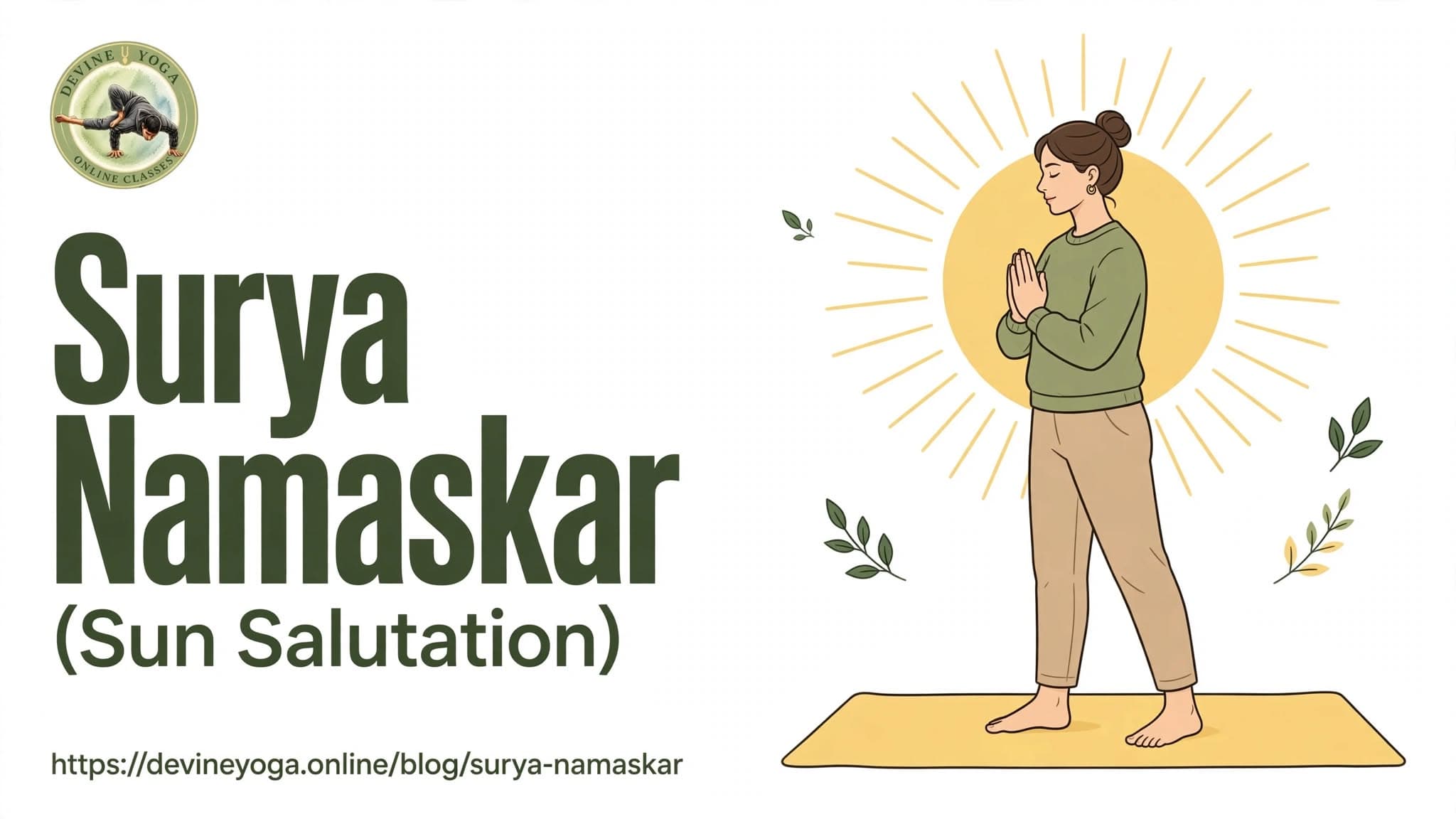
Surya Namaskar, also called Sun Salutation or Surya Asana, is a sequence of 12 linked yoga poses performed with controlled breathing. It combines stretching, strengthening, and breath awareness in one flowing practice. Whether you are a complete beginner or an experienced yogi, it is one of the simplest ways to warm up the whole body.
In this guide you will learn the 12 stages of Surya Namaskar, the correct Surya Namaskar steps with breathing cues, the mantras, the benefits, and the safety precautions.
What Is Surya Namaskar?
"Surya" means sun and "Namaskar" means salutation or bowing. Surya Namaskar is a practice of gratitude toward the sun, the source of energy and life. It is traditionally linked to Indian yogic culture and is widely taught today in yoga schools, fitness studios, and school wellness programs, including those promoted by the Government of India's AYUSH ministry.
One full round has two sets of 12 poses. The first set leads with the right leg and the second with the left. This is why a "round" is sometimes counted as 24 poses.
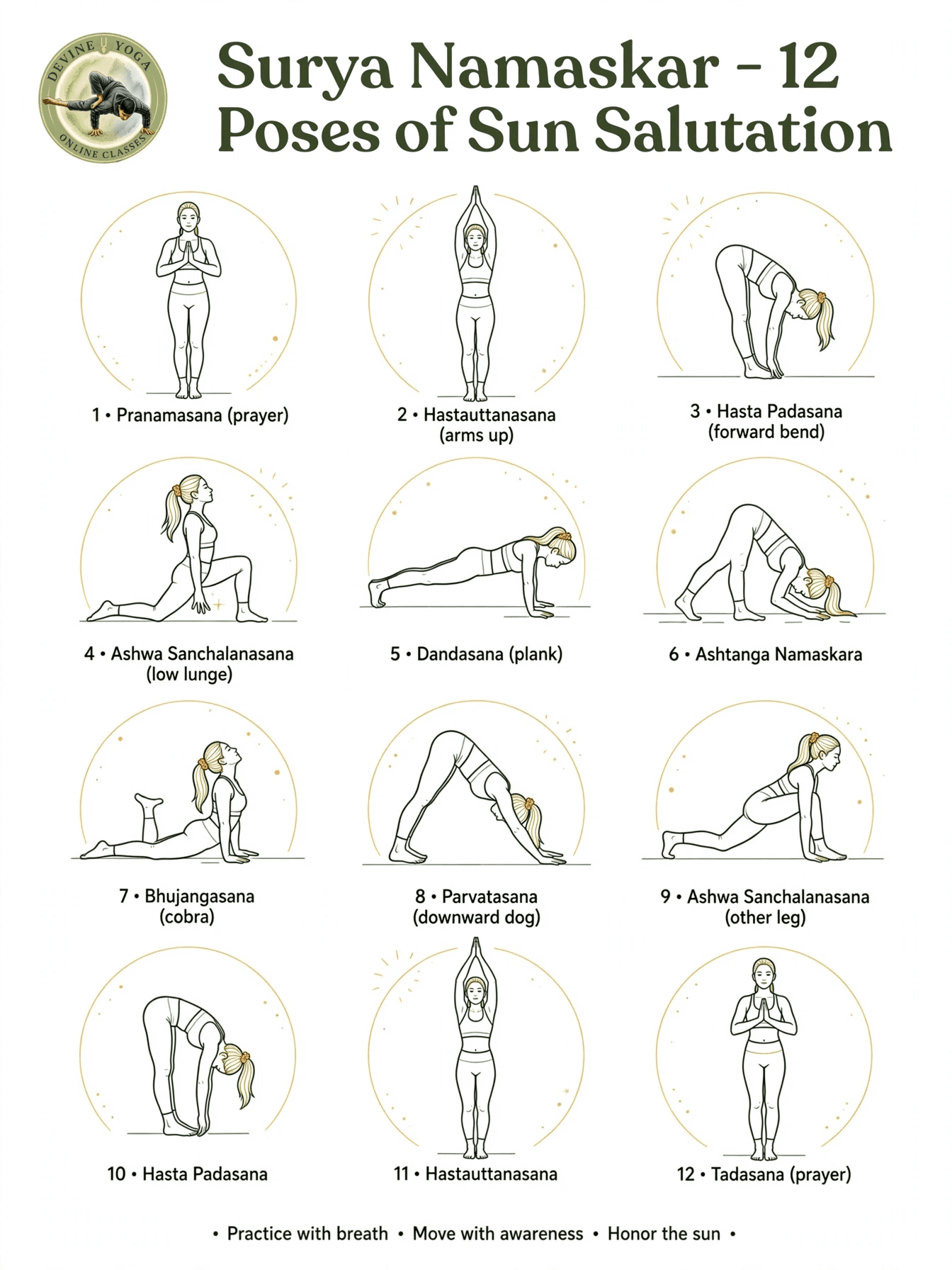
12 Stages of Surya Namaskar: Step-by-Step Guide
Below are the Surya Namaskar poses in order, with the breath and the traditional mantra for each step.
1. Pranamasana (Prayer Pose)
Stand at the front of your mat with feet together. Bring your palms together at the chest and relax the shoulders. Breathe out.
Mantra: Om Mitraya Namah
2. Hasta Uttanasana (Raised Arms Pose)
Inhale, lift both arms overhead, and gently arch the upper back. Keep the biceps near your ears.
Mantra: Om Ravaye Namah
3. Padahastasana (Standing Forward Bend)
Exhale and bend forward from the hips, bringing your palms or fingertips to the floor beside your feet. Bend your knees slightly if your hamstrings are tight.
Mantra: Om Suryaya Namah
4. Ashwa Sanchalanasana (Equestrian Pose)
Inhale and step your right leg back, lowering the knee. Look up and keep the left foot between your palms.
Mantra: Om Bhanave Namah
5. Parvatasana (Mountain or Downward-Facing Dog Pose)
Exhale, step the left foot back, and lift your hips to form an inverted V. Press your heels toward the floor.
Mantra: Om Khagaya Namah
6. Ashtanga Namaskara (Eight-Limbed Salutation)
Lower your knees, chest, and chin to the floor while keeping the hips slightly raised. Eight points touch the ground: two feet, two knees, two hands, chest, and chin. Hold the breath briefly.
Mantra: Om Pushne Namah
7. Bhujangasana (Cobra Pose)
Inhale, slide forward, and lift your chest while keeping the hips on the floor. Keep the shoulders away from the ears.
Mantra: Om Hiranya Garbhaya Namah
8. Parvatasana (Mountain Pose)
Exhale, curl the toes under, and lift the hips back into the inverted V.
Mantra: Om Marichaye Namah
9. Ashwa Sanchalanasana (Equestrian Pose)
Inhale and bring the right foot forward between your palms. Drop the left knee and look up.
Mantra: Om Adityaya Namah
10. Padahastasana (Forward Bend)
Exhale, bring the left foot forward, and straighten the legs into a forward fold.
Mantra: Om Savitre Namah
11. Hasta Uttanasana (Raised Arms Pose)
Inhale, roll the spine up, raise the arms overhead, and arch back slightly.
Mantra: Om Arkaya Namah
12. Pranamasana (Prayer Pose)
Exhale, lower the arms, and return to the prayer position. Repeat the sequence, this time stepping back with the left leg first to complete one round.
Mantra: Om Bhaskaraya Namah
Note: Some schools place Dandasana (plank) in step 5 instead of Parvatasana. Both versions are valid, so follow the one your teacher uses.
When Is the Best Time to Do Surya Namaskar?
Surya Namaskar is traditionally associated with morning practice, particularly in relation to the symbolism of greeting the sun.
However, the most practical time for yoga depends on your routine and consistency.
If mornings work well for you, you can include Surya Namaskar in your morning yoga practice.
If your schedule is busy, you can practice later in the day when you have enough time and an appropriate environment.
The important factors are consistency, adequate space, comfortable clothing, and avoiding practice immediately after a heavy meal.
Benefits of Surya Namaskar
Regular practice may support:
- Flexibility: It stretches the spine, hamstrings, shoulders, and hips.
- Strength: The arms, core, and legs work together throughout the flow.
- Cardiovascular fitness: Faster rounds raise the heart rate, similar to light aerobic activity.
- Stress relief: Synchronising breath and movement calms the mind. Studies on yoga in general report reduced stress and improved mood. For more, see our guide to yoga for stress relief.
- Better posture: It strengthens the back and opens the chest.
- Digestion and circulation: The forward bends and backbends massage the abdominal organs and improve blood flow.
- Weight management: It burns calories as part of an active lifestyle. The amount varies by pace, body weight, and number of rounds.
Common Mistakes While Doing Surya Namaskar
Rushing Through the Sequence
Moving too quickly can make it difficult to maintain proper breathing and alignment.
Better approach: Slow down and learn each transition.
Forcing the Forward Fold
Trying to touch the floor by rounding the back or forcing the hamstrings can make the movement uncomfortable.
Better approach: Bend your knees and fold from the hips as comfortably as possible.
Dropping the Hips in Plank
Allowing the hips to sag can reduce stability.
Better approach: Engage your core and maintain a controlled body position.
Overextending in Cobra Pose
A deep backbend is not necessary for an effective Cobra Pose.
Better approach: Lift your chest only as far as you can without discomfort.
Ignoring Breathing
Holding your breath can make the sequence feel unnecessarily difficult.
Better approach: Keep your breathing steady and coordinate it with your movements.
Is Surya Namaskar Good for Beginners?
Yes, Surya Namaskar can be adapted for beginners, but the traditional sequence may initially feel challenging if you have limited mobility, strength, or yoga experience.
Beginners can modify movements by:
- Keeping the knees bent during forward folds
- Lowering the knees during plank transitions
- Using a shorter range of motion
- Practicing each pose separately
- Moving slowly instead of following a fast-paced flow
- Working with a qualified yoga teacher when learning technique
The goal is not to perfectly copy someone else's posture. The goal is to develop controlled, comfortable movement.
Final Thoughts
Surya Namaskar is more than a sequence of 12 yoga poses. It combines movement, breathing, coordination, and awareness into one flowing practice.
For beginners, the best way to learn the Surya Namaskar steps is to first understand each posture individually and then gradually connect them into a smooth sequence.
Whether you practice two rounds or several rounds, focus on controlled movement, comfortable range of motion, steady breathing, and consistency.
If you are unsure about your technique, learning with an experienced yoga teacher can help you develop a safe and sustainable practice.
At Devine Yoga, we believe yoga should be approachable, consistent, and adapted to the individual rather than treated as a one-size-fits-all routine. If you're looking to build a regular yoga practice from home, guided online classes can provide structure and teacher support.
Ready to make yoga part of your daily routine? Explore Devine Yoga and start your practice.
Frequently asked questions
How many Surya Namaskar should I do daily?
Beginners can start with 3 to 5 rounds. Experienced practitioners often do 12 rounds, and some do 108 on special occasions. Increase gradually.
How many steps are in Surya Namaskar?
There are 12 steps in one set. A full round consists of two sets, one for each side.
Can Surya Namaskar help reduce belly fat?
It can support fat loss when combined with a healthy diet and regular activity. It does not target belly fat alone.
Is Surya Namaskar good for beginners?
Yes, when practised slowly with modifications. Learning from a certified teacher at first is recommended.
Should Surya Namaskar be done on an empty stomach?
Yes. Morning practice before breakfast is ideal.
Reading is a start. A live teacher is the shortcut.
In a Devine Yoga class your trainer sees you, corrects you by name and adapts every pose to your body - beginners included.