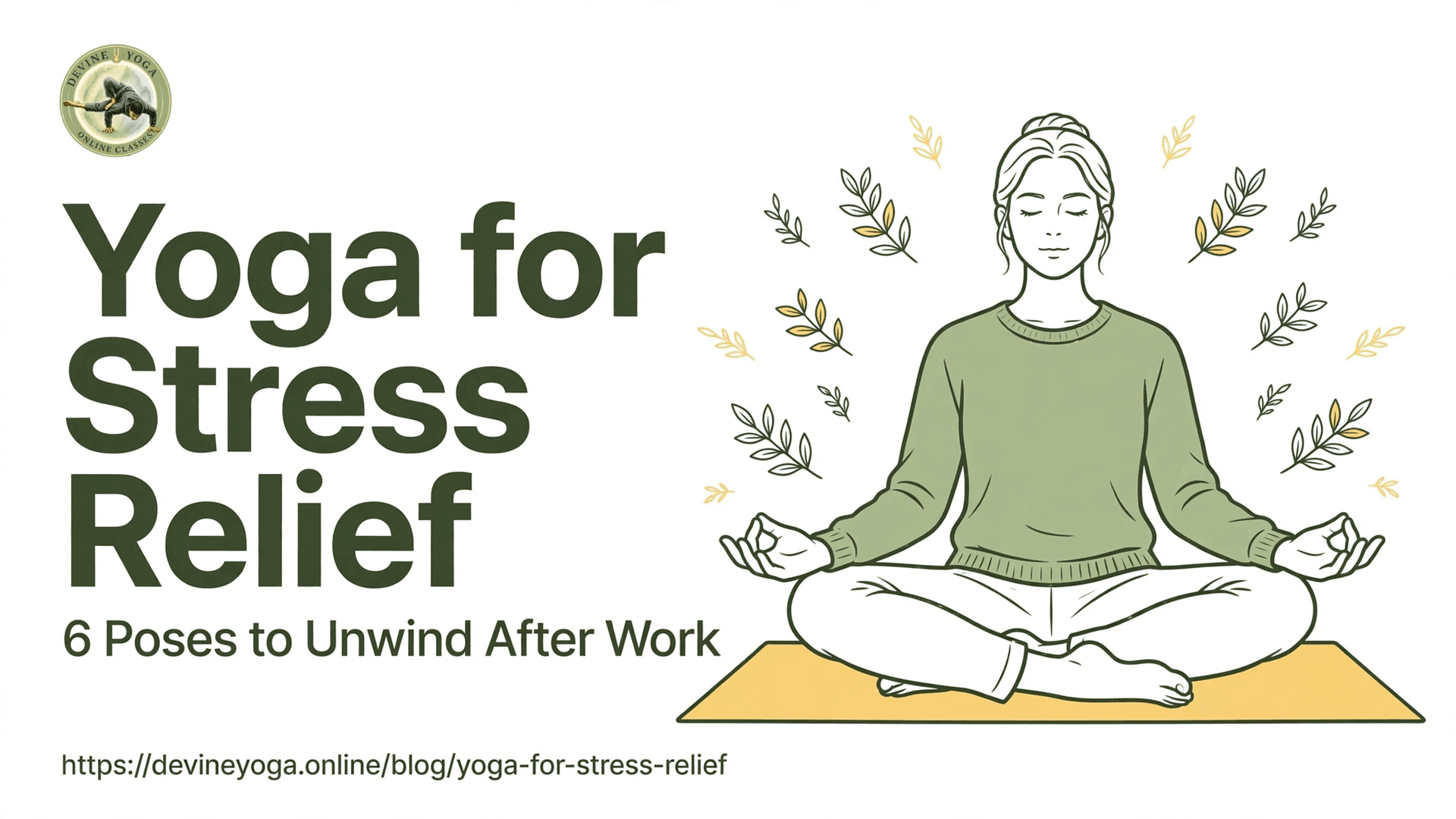
Yoga for Stress Relief: 6 Poses to Unwind After Work
Six simple yoga poses and one breathing technique to release a stressful workday - a 15-minute wind-down routine you can do at home tonight.
Summarize this blog with:
Stress lives in the body long after the workday ends - a tight jaw, shallow breath, shoulders up near your ears. This short routine is designed to move that tension out before it follows you to bed.
You need a mat, a couple of metres of clear floor, and about fifteen minutes.
Why stress shows up in your body
When you are under pressure, your body reacts as if something urgent is happening. Your breathing becomes quicker and higher in the chest, your shoulders lift, your jaw and hands tighten, and your attention narrows. That is useful for a real emergency. It is much less useful when the "emergency" is an inbox, a deadline or a long commute.
The trouble is that these habits often stay switched on after you log off. Many people carry them into the evening without noticing, and then wonder why they feel wired but tired at bedtime.
Yoga helps because it gives you something simple to do with that tension. Slow movement, steady breathing and a few minutes of stillness give your mind a single, calm thing to follow, instead of ten worries at once.
Before you begin
- Pick a quiet corner. Dim the lights if you can and put your phone on silent.
- Wear something comfortable that lets you bend and breathe freely.
- Eat lightly. Try to finish your last meal at least two hours before, so a forward fold or twist does not feel heavy.
- Move gently. Nothing here should hurt. A mild stretch is fine; sharp or pinching pain is your cue to ease off or stop.
Start with the breath
Before any pose, sit tall and breathe in for a count of four, then out for a count of six. The longer exhale is what signals your nervous system to stand down. Do this for ten rounds.
How to do it:
- Sit comfortably, on the floor or on a chair, with a long spine.
- Breathe in through your nose for a slow count of four.
- Breathe out through your nose (or softly through your mouth) for a count of six.
- Let your shoulders and jaw soften on every exhale.
If a count of six feels like too much, try three in and four out. The aim is a calm, unforced rhythm, not a breath-holding contest.
The six poses
- Child's pose - 8 slow breaths. Lets the lower back spread and the forehead rest.
- Cat–cow - 6 rounds, moving with your breath.
- Standing forward fold - 5 breaths, knees soft, head heavy.
- Low lunge - 5 breaths each side, opening the front of the hip where we hold desk tension.
- Seated twist - 5 breaths each side.
- Legs up the wall - 3 to 5 minutes. This is the one that matters most.
1. Child's pose
Kneel on the mat, bring your big toes together and let your knees open wide. Sit your hips back towards your heels and walk your hands forward, resting your forehead on the floor.
- Why it helps: the folded shape gently rounds the back and gives your forehead something to rest on, which many people find instantly calming.
- Make it easier: place a cushion or folded blanket under your forehead or between your hips and heels. If your knees complain, put a rolled towel behind them.
2. Cat–cow
Come onto your hands and knees, with wrists under shoulders and knees under hips. As you breathe in, let your belly drop and lift your chest (cow). As you breathe out, round your back and tuck your chin (cat).
- Why it helps: it links movement to breath, which gives a busy mind a clear job, and it wakes up a spine that has been still all day.
- Watch for: moving too fast. Let each breath decide the pace.
3. Standing forward fold
Stand with your feet hip-width apart. Bend your knees generously and fold forward from the hips, letting your head and arms hang heavy. You can hold opposite elbows and sway slightly.
- Why it helps: letting the head hang releases the neck and upper back, two places where stress collects.
- Make it easier: keep your knees well bent, or rest your hands on a chair or the wall. Never force your legs straight.
4. Low lunge
From a forward fold, step one foot back and lower the back knee to the mat. Keep the front knee over the ankle and lift your torso, hands on the front thigh or reaching up.
- Why it helps: long hours of sitting leave the front of the hips tight, and this pose opens that area gently.
- Make it easier: pad the back knee with a folded blanket, and keep your hands on the floor or on blocks if balance feels shaky.
5. Seated twist
Sit with your legs crossed or extended. Place your right hand behind you and your left hand on your right knee, then twist slowly to the right on an exhale. Repeat on the other side.
- Why it helps: a gentle twist releases the muscles around the spine and encourages a full, easy breath.
- Watch for: cranking the twist with your arms. Lengthen up with each inhale and turn only as far as feels comfortable.
6. Legs up the wall
Sit sideways next to a wall, then swing your legs up as you lie back. Your hips can be right against the wall or a little way out, whatever is comfortable. Rest your arms by your sides and let your eyes close.
- Why it helps: it is a fully supported rest position. There is nothing to hold or achieve, which is exactly what a stressed body needs.
- Make it easier: place a folded blanket under your hips. If this position is uncomfortable for you, lie on your back with your calves resting on a chair or sofa instead.
- Stay here: 3 to 5 minutes, breathing slowly with the same 4-in, 6-out rhythm.
A 15-minute evening wind-down
| Time | What to do |
|---|---|
| 0:00 – 2:00 | Seated 4-and-6 breathing |
| 2:00 – 4:00 | Child's pose |
| 4:00 – 6:00 | Cat–cow |
| 6:00 – 8:00 | Standing forward fold |
| 8:00 – 10:00 | Low lunge, both sides |
| 10:00 – 11:30 | Seated twist, both sides |
| 11:30 – 15:00 | Legs up the wall, then a few quiet breaths |
If you are short on time, use the five-minute version: ten rounds of the breath, Child's pose, and two minutes of Legs up the wall.
Common mistakes to avoid
- Treating it like a workout. This is a wind-down, not a performance. Go slower than you think you need to.
- Holding your breath. If you notice it, soften your jaw and return to the long exhale.
- Stretching into pain. Stress already makes the body tense. Forcing a stretch can make it tighter.
- Checking your phone mid-practice. Leave it in another room for the fifteen minutes.
- Giving up after one day. One session feels good, but the real benefit comes from repeating it. See our guide to common yoga mistakes beginners make for more on this.
Make it stick
The routine works best when it is boring and repeatable. Same time, same order, every evening. Within a fortnight most students tell us they reach for it automatically on a hard day.
A few ways to build the habit:
- Anchor it to something you already do, such as changing out of your work clothes or making tea.
- Keep your mat visible, rolled out or leaning against a wall.
- Start small. Five minutes counts. You can always do more.
- Track it. A tick on the calendar for each day makes it harder to skip.
If you sit at a desk most of the day, our yoga for desk workers guide has short chair-based movements you can do between meetings, and our post on the best time to do yoga explains how to choose between a morning and an evening practice.
A note on safety
This routine is gentle, but everyone's body is different. Please check with a doctor before starting if you are pregnant, have a recent injury, high blood pressure, or any condition that affects your balance or joints. Yoga is a helpful habit for everyday stress, not a replacement for medical or mental health care. If you feel persistently overwhelmed, anxious or low, please talk to a professional.
Ready for a teacher?
When you want a live teacher watching your alignment and adjusting each pose to your body, that is exactly what our classes are for - see the programs and pricing. If you are new to yoga, our guide to Hatha yoga for beginners is a good place to start.
Frequently asked questions
How long before I feel calmer?
Most people notice their shoulders drop and their breathing slow within the first five minutes. The full effect of a wind-down routine builds over two to three weeks of near-daily practice.
Is this safe if I have never done yoga?
Yes. Every pose here has a gentle range, and you stop the moment anything feels sharp. If you have a specific injury, tell your trainer before class so they can adapt it.
What time of day is best?
Within an hour of finishing work, or just before bed. Practising at the same time each day makes it a habit far faster.
Can I do this routine if I only have five minutes?
Yes. Do ten slow rounds of the 4-and-6 breath, then Child's pose and Legs up the wall for two minutes each. A short routine done every day does more for stress than a long one done once a week.
Can yoga replace professional help for stress or anxiety?
No. Yoga can be a helpful everyday habit for winding down, but it is not a treatment. If stress is affecting your sleep, mood or health for weeks at a time, please speak to a doctor or a qualified mental health professional.
Reading is a start. A live teacher is the shortcut.
In a Devine Yoga Online class your trainer sees you, corrects you by name and adapts every pose to your body - beginners included.
Most popular blogs
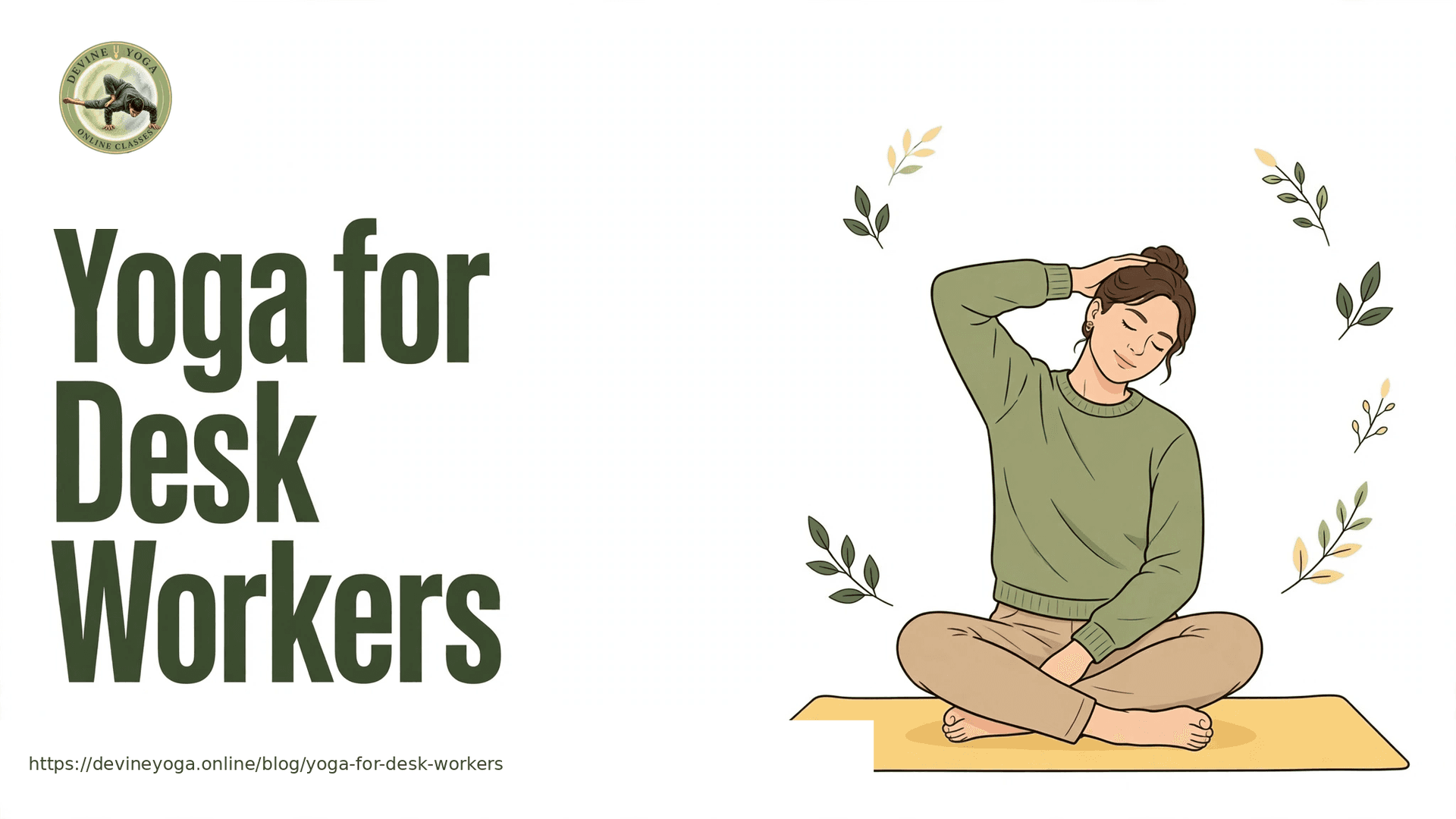
Yoga for Desk Workers: Ease Stiffness and Stress
Discover gentle desk yoga stretches, chair yoga routines, and yoga tips to ease everyday stiffness and manage workday stress at home.
Published:
8 min read
7-Day Yoga Challenge 2027: Start Your Wellness Journey
Start your 7-Day Yoga Challenge 2027 with simple daily poses, breathing exercises and mindfulness practices. Build a healthier wellness routine.
Published:
7 min read
Yoga for Depression and Anxiety in 2027
Discover how yoga for depression and anxiety in 2027 may support mental health with gentle poses, breathing techniques, and safe routines.
Published:
12 min read