Anulom Vilom: Complete Guide by Devine Yoga Online
Master Anulom Vilom. Learn correct steps, proven scientific benefits, mistakes to avoid, and safe daily practices.
Summarize this blog with:
What is Anulom Vilom?
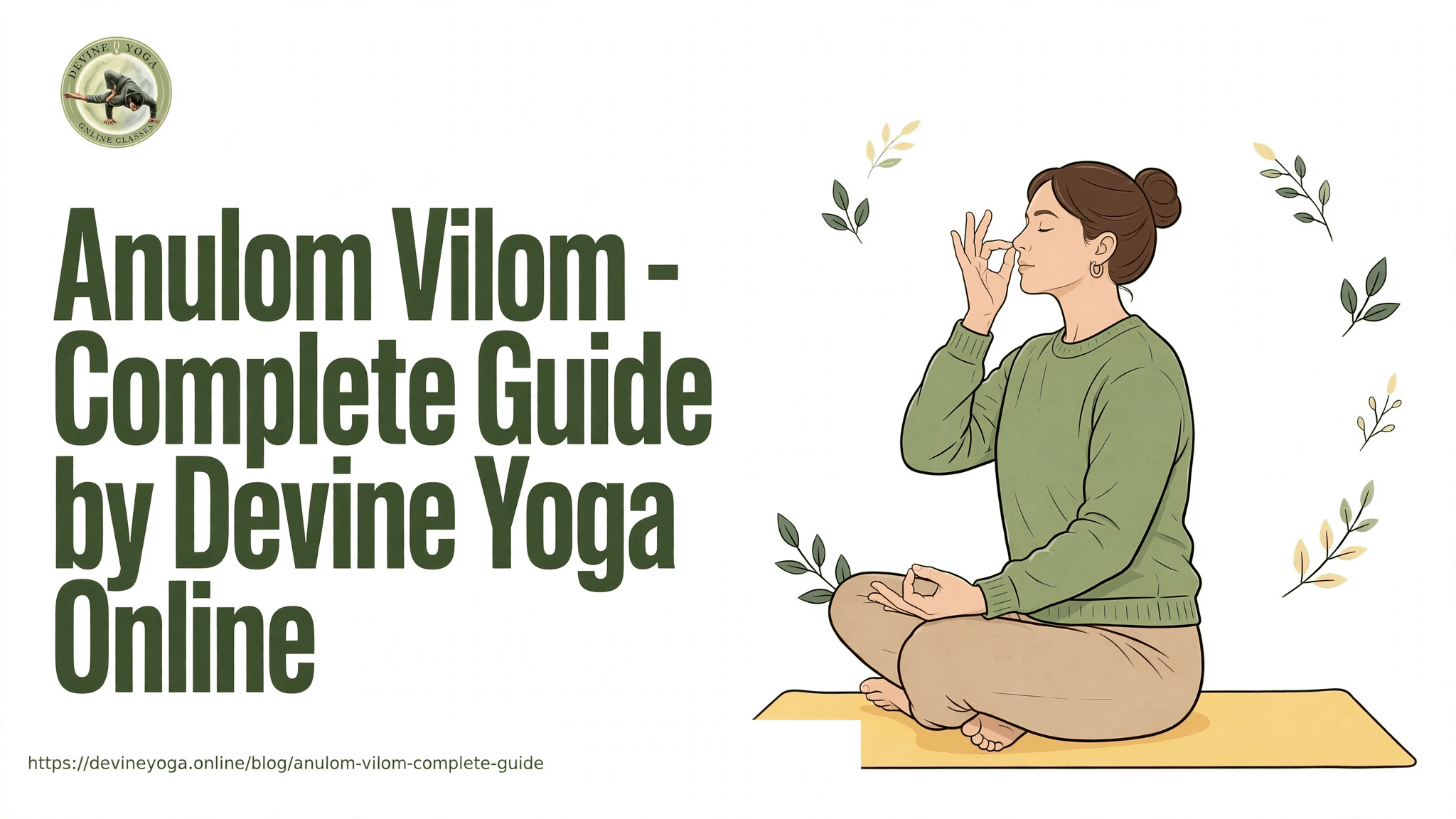
Anulom Vilom is a pranayama technique of alternate nostril breathing, where each inhale and exhale is directed through one nostril at a time. The name comes from Sanskrit: anuloma means "with the grain" and viloma means "against the grain," describing the back-and-forth flow of breath from one side to the other.
You may also see it called Nadi Shodhana, meaning "channel purification." Teachers use the two names differently. Many schools treat them as the same practice. Others use Anulom Vilom for the simple version without breath holding, and Nadi Shodhana for the version with retention (kumbhaka). This guide teaches the simple, beginner-safe version.
In plain terms, Anulom Vilom is a slow, rhythmic breathing exercise where you gently close one nostril at a time with your fingers and breathe in a steady pattern: in through one side, out through the other, then back again. It takes only a few minutes, needs no equipment and can be done seated on the floor or on a chair.
Disclaimer: Always consult a healthcare professional before starting any new breathing practice, especially if you have a heart, blood pressure or respiratory condition, or are pregnant.
Where does Anulom Vilom come from?
Anulom Vilom comes from the Hatha yoga tradition of India. The Hatha Yoga Pradipika (15th century, Svatmarama) describes alternate nostril breathing as a way to purify the nadis, the subtle channels through which prana (life energy) is said to flow.
In traditional yogic thought, the left channel (ida) is linked with cooling, calming energy and the right channel (pingala) with warming, active energy. Anulom Vilom is meant to balance the two. These are traditional concepts, not measured anatomy, and we present them as part of yoga's philosophy rather than as medical facts.
How do you do Anulom Vilom step by step?
Sit comfortably, close one nostril with your thumb, inhale through the other, then switch sides for the exhale. One full cycle is a "round."
Before you start
- Sit in Sukhasana (Easy Pose), Vajrasana (Thunderbolt Pose) or on a chair with your spine tall.
- Rest your left hand on your left knee, palm up or in Jnana mudra (thumb and index finger touching).
- Raise your right hand into Vishnu mudra: fold the index and middle fingers toward the palm. The thumb will close the right nostril and the ring finger the left.
- Take two or three natural breaths first.
The practice
- Exhale fully through both nostrils.
- Close the right nostril with your thumb. Inhale slowly through the left for a count of 4.
- Close the left nostril with your ring finger, release the thumb, and exhale through the right for a count of 4.
- Inhale through the right nostril for 4.
- Close the right, release the left, and exhale through the left for 4.
- That is one round. Begin with 5 rounds and build up to 5 to 10 minutes.
Keep these in mind
- Breathe silently. If you can hear the breath, it's too forceful.
- Keep the face, jaw and shoulders soft.
- Use light finger pressure. You're guiding the breath, not squeezing the nose.
- Once the 4-count feels easy, you can lengthen the exhale gently (for example, in 4, out 6). Avoid straining.
What are the benefits of Anulom Vilom?
Slow, controlled breathing practices like Anulom Vilom may help with relaxation, stress and focus, though research is still limited and results vary. A 2017 systematic review of clinical trials on alternate nostril breathing (Ghiya, International Journal of Research in Medical Sciences) noted possible effects on blood pressure, heart rate and stress measures, but also highlighted that many studies were small and varied in quality.
Benefits students commonly report:
- A calmer mind: the slow, counted rhythm gives the mind one thing to follow.
- Better focus: many people use it before study, work or meditation.
- Easier relaxation and sleep: a short evening practice can help the body wind down.
- Greater breath awareness: you start to notice how you breathe during the day.
- Improved breath control: the practice trains slow, even inhalation and exhalation.
Anulom Vilom is not a treatment for any disease. Claims that it cures conditions such as diabetes, thyroid problems or heart blockages are not supported by solid evidence. Please treat it as a complement to medical care, not a replacement.
How does Anulom Vilom work? Anatomy and nervous system
Anulom Vilom works by stimulating the vagus nerve and balancing nasal cycle dominance, which shifts the autonomic nervous system from sympathetic (stress) to parasympathetic (calm).
Here's what happens physiologically:
1. The nasal cycle: Science calls it the nasal cycle - every 90-120 minutes, one nostril naturally becomes more dominant. Right nostril dominance correlates with higher alertness, left with restfulness. Alternate nostril breathing consciously resets this cycle.
2. Vagal tone: Slow, extended exhalation (especially longer than inhalation) stimulates the vagus nerve, the longest cranial nerve. This lowers heart rate and blood pressure.
3. Carbon dioxide tolerance: By slowing breath to 4-6 breaths per minute (normal is 12-20), you train your chemoreceptors to tolerate more CO2, which actually improves oxygen delivery to tissues - this is called the Bohr effect.
This is why after Anulom Vilom you don't just feel relaxed, you feel more oxygenated and clear-headed without hyperventilating.
10 common Anulom Vilom mistakes and how to fix them
1. Breathing too fast or too forcefully
Why it happens: Beginners treat it like exercise and think a bigger breath means a better practice. Others rush to finish the rounds.
What goes wrong: Forceful breathing can cause lightheadedness, tingling in the hands or face, and a racing feeling, which is the opposite of the calming effect you want. It also turns a relaxation practice into a stimulating one.
How to fix it:
- Aim for a breath so quiet that someone sitting next to you couldn't hear it.
- Let the inhale fill about 70 to 80 percent of your lungs, not 100 percent.
- Start with a 3-count or 4-count and only lengthen when it feels effortless.
- If you notice the breath getting "grabby" or sharp, pause and take three natural breaths.
Teaching cue: "Breathe as if you're fogging a window slowly, not blowing out a candle."
2. Holding the breath (retention) too early
Why it happens: Many online videos and books show kumbhaka (breath retention) as part of Anulom Vilom or Nadi Shodhana, so beginners add it without preparation.
What goes wrong: Retention raises carbon dioxide levels and can strain the body if the lungs and nervous system aren't conditioned. It can cause dizziness, chest tightness, anxiety or a feeling of panic. It is also the main reason blood pressure and heart conditions are listed as cautions.
How to fix it:
- Skip retention completely for the first several weeks, ideally months.
- Build the foundation first: smooth, even inhales and exhales with no strain.
- Add holds only with a qualified teacher who can watch you in person or live online.
- If you later practice ratios, introduce them gradually, and never hold until you feel desperate to breathe.
3. Pressing too hard on the nose
Why it happens: Beginners try to "seal" the nostril completely, pressing hard with the thumb and ring finger.
What goes wrong: Heavy pressure bends the cartilage, makes the breath noisy, creates facial tension and distracts from the practice. Some people also develop soreness around the nose.
How to fix it:
- Press on the soft, fleshy side of the nose just below the bony bridge, not on the bone.
- Use the lightest pressure that closes the nostril, like closing a door gently.
- Let the fingertips rest rather than push.
- Keep the elbow of your working arm relaxed and slightly away from the body.
4. Tense shoulders, arm and face
Why it happens: Holding the right hand up for several minutes tires the arm, and the body compensates by lifting the shoulder. Concentration often tightens the jaw and forehead.
What goes wrong: Tension restricts the rib cage and diaphragm, so the breath becomes shallow and chest-based. Arm fatigue also pulls attention away from the breath.
How to fix it:
- Do a quick scan every two or three rounds: shoulders down, jaw loose, tongue soft, forehead smooth.
- Support the elbow with a cushion, or rest it on the opposite hand if the arm tires.
- Keep the left hand relaxed on the knee in Jnana mudra.
- Take a break and lower the arm between sets if needed.
5. Slouching or an unstable sitting posture
Why it happens: Tight hips or a weak back make floor sitting uncomfortable, so the spine rounds and the pelvis tucks under.
What goes wrong: A collapsed chest limits the diaphragm and lungs, so you can't take a full, easy breath. Discomfort in the knees or back also keeps the mind on the body instead of the breath.
How to fix it:
- Sit on a folded blanket or cushion so the hips are higher than the knees.
- Place blocks or pillows under the knees if they float in the air.
- Use a chair or Vajrasana if floor sitting hurts. The spine matters more than the pose.
- Imagine a string gently lifting the crown of your head, keeping the chest open without arching the back.
6. Practicing with a blocked nose or after eating
Why it happens: People practice whenever they have time, without checking how they feel.
What goes wrong: A blocked nose makes the breath forced and noisy. A full stomach presses on the diaphragm, which makes deep breathing uncomfortable and can cause nausea or bloating.
How to fix it:
- Wait 3 to 4 hours after a heavy meal and 1 to 2 hours after a light snack.
- If you have a mild cold, practice very gently or switch to simple natural breathing with a long exhale.
- Don't practice during a severe cold, sinus infection or fever.
- A few gentle neck and shoulder rolls before you start can help open the airways for some people.
7. Losing count and mixing up sides
Why it happens: The mind wanders, or the sequence feels confusing, especially in the first few weeks.
What goes wrong: Confusion creates frustration and mental effort, which defeats the calming purpose. Some beginners end up breathing in through the same nostril twice, or switch at the wrong moment.
How to fix it:
- Remember the rule: inhale on one side, exhale on the other, then inhale on the same side you just exhaled.
- Say it as a phrase: "In left, out right, in right, out left."
- Start with just 3 rounds and focus on the pattern before building duration.
- Count silently, or use a gentle timer or audio guide.
8. Chasing results and overpracticing
Why it happens: People read about dramatic benefits online and expect fast change, so they practice for 30 minutes or more, or multiple times a day.
What goes wrong: Overpracticing can lead to fatigue, dizziness, headaches or irritability. Chasing results also adds pressure, which defeats the purpose. And it can fuel disappointment when the claimed cures don't happen.
How to fix it:
- Start with 5 minutes and add 1 to 2 minutes each week.
- Stay at 10 to 15 minutes for general wellbeing. More is not necessarily better.
- Judge progress by how you feel afterward (steadier, calmer, more aware), not by dramatic outcomes.
- Be wary of any source claiming pranayama cures serious diseases.
9. Ignoring warning signs
Why it happens: Some students believe discomfort is "the practice working" or "toxins being released."
What goes wrong: Dizziness, chest tightness, palpitations, tingling or a feeling of panic are signals to stop, not to push through. Ignoring them can be unsafe, especially for people with heart, blood pressure or respiratory conditions.
How to fix it:
- Stop, release the hand and breathe naturally. Sit quietly until you feel normal.
- Return only when comfortable, with a shorter, gentler practice.
- If symptoms repeat or are intense, speak with a doctor before continuing.
- Tell your teacher about any health condition, so they can modify the practice.
10. Learning only from videos and never getting feedback
Why it happens: Free videos are easy and convenient, and many learners never have a teacher check them.
What goes wrong: Small errors in posture, breathing rhythm or finger placement go uncorrected for months. Videos also rarely adapt to your health conditions or experience level.
How to fix it:
- Join at least a few live classes, in person or online, where a teacher can see you.
- Record yourself for a minute and compare it to the teacher's demonstration.
- Ask your teacher to check your posture, finger position and breath sound.
Frequently asked questions
What is Anulom Vilom in simple words?
Anulom Vilom is a yogic breathing exercise where you breathe in through one nostril and out through the other, then switch sides. It is also called alternate nostril breathing. It's practiced to calm the mind, build breath awareness and support relaxation.
Is Anulom Vilom the same as Nadi Shodhana?
They are very similar and often used interchangeably. Some teachers use Anulom Vilom for the simple version without breath retention and Nadi Shodhana for the version with holds. Both involve alternate nostril breathing, so check with your teacher which they mean.
Can I do Anulom Vilom on an empty stomach?
Yes, an empty stomach is actually preferred. Early morning is traditional, but any time works if your last meal was 3 to 4 hours ago. Avoid practicing right after eating, as a full stomach makes deep breathing uncomfortable.
Does Anulom Vilom help with anxiety or stress?
Slow, controlled breathing may help many people feel calmer, and small studies suggest stress-related benefits. However, it is not a treatment for anxiety disorders. If anxiety is affecting daily life, speak with a doctor or mental health professional alongside your practice.
Who should avoid Anulom Vilom?
People with heart conditions, blood pressure problems, asthma or other respiratory illness, those who are pregnant, and anyone with a blocked nose or recent surgery should seek medical advice first. Skip breath holding unless a qualified teacher supervises.
Reading is a start. A live teacher is the shortcut.
In a Devine Yoga Online class your trainer sees you, corrects you by name and adapts every pose to your body - beginners included.
Related blogs
Pranayama: Types, Benefits and How to Do Them
What is Pranayama? Learn 8 types of pranayama, benefits, correct steps, ratios & precautions. Complete beginner guide from Devine Yoga.
11 min read
Yoga Mistakes Beginners Make
Discover the most common yoga mistakes beginners make and learn simple, practical fixes to improve your alignment, breathe better, and practise safely.
8 min read
Yoga for Desk Workers: Ease Stiffness and Stress
Discover gentle desk yoga stretches, chair yoga routines, and yoga tips to ease everyday stiffness and manage workday stress at home.
8 min read