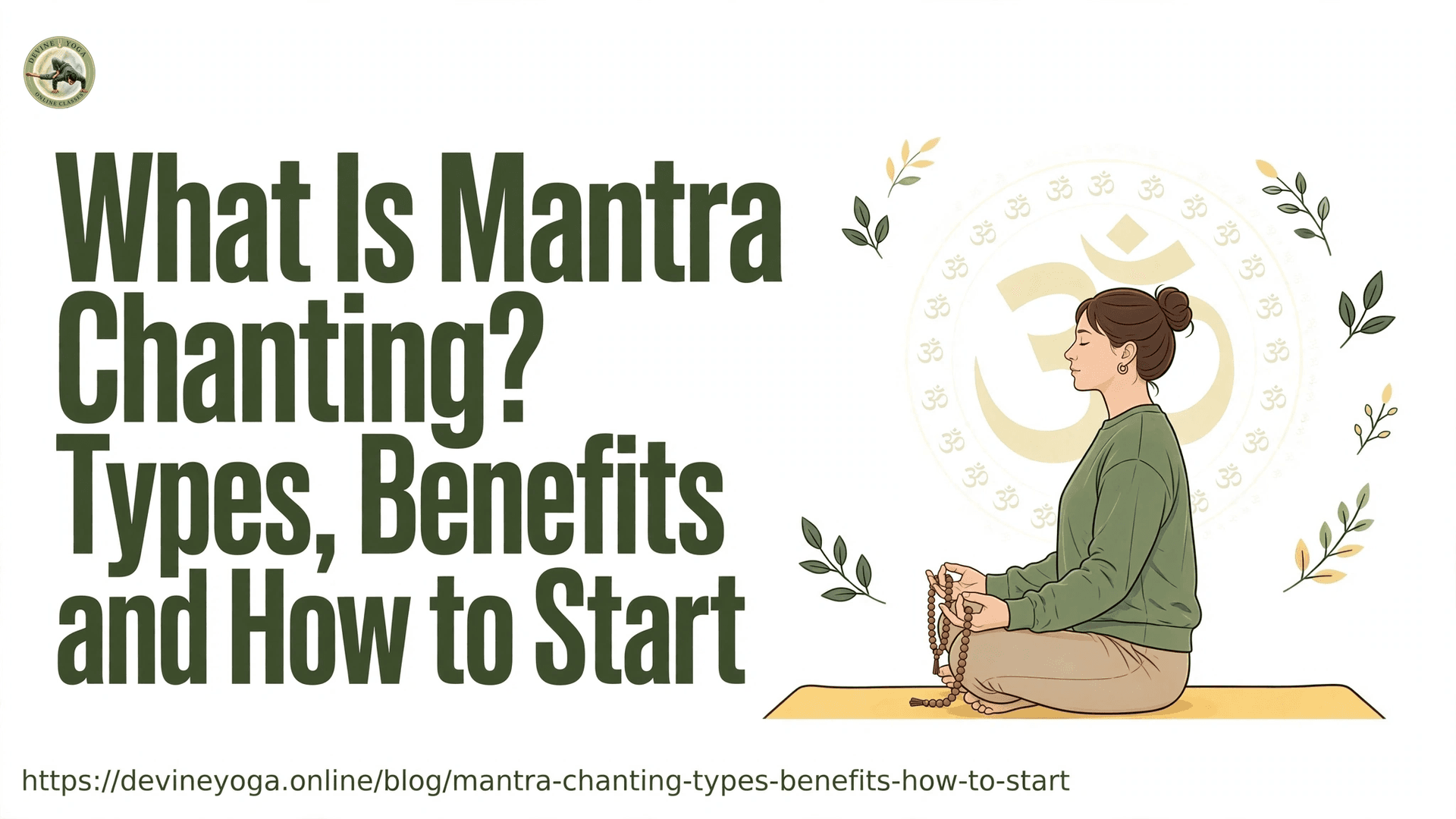
What Is Mantra Chanting? Types, Benefits and How to Start
Discover mantra chanting, its types and benefits, plus a simple step-by-step guide on how to chant Maha Mrityunjaya, Om Namah Shivaya and Hare Krishna.
Summarize this blog with:
The word 'mantra' comes from Sanskrit roots. 'Manas' means 'mind', and 'tra' means 'instrument' or 'protection'. A mantra is literally a tool that protects and steadies the mind from its own restless currents.
Have you ever repeated a Sanskrit phrase during yoga, meditation, prayer, or a temple ritual and wondered why people chant it again and again? Mantra chanting is the practice of repeatedly reciting a sacred sound, word, name, or phrase, either aloud, softly, or mentally. In Indian spiritual traditions, chanting is used not only as an act of devotion but also as a method of concentration and contemplative practice.
The tradition is ancient, with mantras appearing throughout Vedic literature and later developing in many Hindu, Buddhist, and other Indian spiritual traditions.
A Brief History and Spiritual Significance
Mantra chanting traces back over 3,000 years to the Rigveda, the oldest of the four Vedas. Rishis, or seers, composed hymns not just to be read but to be chanted with precise intonation. The text itself notes the meter and the way it should be voiced.
The history of mantra chanting cannot be reduced to one single practice or one single religious school.
In the Vedic tradition, mantras were transmitted orally with considerable attention to pronunciation, accent, metre, and continuity of recitation. The Vedic heritage therefore treats sound as more than ordinary speech: the exact form of a mantra can be part of the practice itself. The Rigveda's organisation into suktas, riks, metres, seers, and deities illustrates this highly structured tradition.
The Upanishads shifted much attention toward philosophical inquiry, consciousness, self-knowledge, and the relationship between sound and reality. Om became especially important in this context.
The later history of mantra practice is even more diverse. Shaiva traditions developed practices centred on Shiva's names and mantras. Vaishnava and Bhakti traditions emphasised repetition of divine names as a direct devotional practice. Tantric traditions developed extensive systems involving bija mantras, visualisation, ritual, initiation, and subtle-body practices.
This diversity matters because there is no single universal rulebook for all mantras.
A mantra given within a particular lineage may have specific pronunciation, initiation, repetition, or ritual requirements. A simple devotional name such as Om Namah Shivaya may be used much more freely in everyday practice.
Respecting the tradition means understanding this difference rather than presenting every mantra as interchangeable.
Types of Mantra Chanting
Not all chanting sounds the same. Tradition describes several ways of chanting, and each type suits a different temperament and situation.
1. Vaikhari Japa (Vocal Chanting)
Chanting out loud so you can hear yourself clearly. Your lips move, breath is engaged. Best for beginners who get sleepy or distracted when silent, and for group settings.
How to do it: Sit comfortably, chant at a steady volume, let the sound fill the room. Use a mala if you wish.
2. Upanshu Japa (Whispered Chanting)
The lips move, but the sound is a whisper, audible only to you. More internal than Vaikhari, it conserves energy and is often used when others are nearby.
Who it suits: People who feel self-conscious chanting aloud or who want a practice they can do in an office or train.
3. Manasika Japa (Mental Chanting)
No movement of lips or tongue. The mantra repeats purely in the mind. Traditionally considered the most subtle and potent, but also the hardest because there is no physical anchor.
Who it suits: Those who have established a steady vocal practice for a few weeks. In practice, mental japa works best after the mantra is memorized in the body first.
4. Kirtan (Call-and-Response Chanting)
A group form where a lead singer chants a line and the group answers. Often accompanied by harmonium, mridanga, or hand claps. This is the living heart of Hare Krishna practice.
Who it suits: People who connect through music and community. Kirtan lifts low energy quickly.
5. Bija Mantras (Seed Sounds)
Single-syllable sounds like Om, Hum, Shreem, Klim. They have no dictionary meaning but are treated as concentrated sound energies linked to elements or deities in tantric texts.
Practice: Usually repeated with longer exhalation and attention on a specific area, like the chest for Om.
6. Likhita Japa (Written Repetition)
Writing the mantra by hand, usually in a notebook, 108 times or more. Combines focus, hand movement, and visual memory.
Who it suits: Those who think best with a pen, or who want to slow racing thoughts.
Comparison table: types of mantra chanting
| Type | Volume | Energy Level | Best For |
|---|---|---|---|
| Vaikhari | Audible | Energizing, grounding | Complete beginners, morning practice |
| Upanshu | Whisper | Balancing | Quiet environments, shy beginners |
| Manasika | Silent | Deeply calming | Experienced practitioners, before sleep |
| Kirtan | Loud + musical | Uplifting, social | Community, low mood, Bhakti path |
| Bija | Audible to silent | Focused | Short focus breaks, breath awareness |
| Likhita | Written | Steadying, mindful | Journalers, people with busy minds |
Popular Mantras and Their Meanings
Maha Mrityunjaya Mantra
This is one of the oldest mantras in the Vedas, found in Rigveda 7.59.12, attributed to Rishi Vashishtha. Also called the Tryambakam Mantra or Rudra Mantra, it is addressed to Tryambaka, the three-eyed Rudra, later understood as Shiva.
Transliteration:
Om Tryambakam Yajamahe Sugandhim Pushtivardhanam
Urvarukamiva Bandhanan Mrityor Mukshiya Ma Amritat
Word-by-word meaning:
- Tryambakam = three-eyed one
- Yajamahe = we worship, we honor
- Sugandhim = fragrant, auspicious
- Pushtivardhanam = nourisher, increaser of well-being
- Urvarukamiva = like a cucumber / gourd from its vine
- Bandhanan = from bondage
- Mrityor = from death / from fear
- Mukshiya = may we be freed
- Ma Amritat = not from immortality, not from our connection to what endures
Significance: It is not a literal plea to avoid physical death. The image of the cucumber falling naturally from the vine when ripe points to release from clinging and fear. Traditional teachers recommend it during transitions, illness, or anxiety, as a prayer for clarity and protection.
How it is traditionally chanted: Best in the early morning after bathing, facing east or north, 108 times using a Rudraksha mala. Many lineages chant it 3, 9, or 27 times daily and 108 times on Mondays or during Pradosha.
Om Namah Shivaya
This is the Panchakshara Mantra, the five-syllable mantra of Shaivism. Its core is found in the Shri Rudram section of the Krishna Yajurveda, Taittiriya Samhita 4.5.8.1.
If you remove Om, you are left with exactly five syllables: Na - Ma - Shi - Va - Ya. Tradition links each to one of the five great elements.
Meaning: A direct translation is "Om, salutations to Shiva, the auspicious one." On a deeper level:
- Na - Earth, grounding
- Ma - Water, flow
- Shi - Fire, transformation
- Va - Air, breath
- Ya - Ether, space
How it is chanted: Pronounced as Om Na-mah Shi-vaa-ya with equal weight. Inhale naturally, chant on the exhale without strain. It works well as a japa mantra with 108 beads because its rhythm naturally slows breathing to about 5-6 breaths per minute, a rate associated with calm alertness.
Hare Krishna Maha Mantra
Hare Krishna Hare Krishna Krishna Krishna Hare Hare
Hare Rama Hare Rama Rama Rama Hare Hare
Earliest textual reference appears in the Kali-Santarana Upanishad, a Vaishnava Upanishad. It rose to prominence in the late 15th and 16th centuries through Chaitanya Mahaprabhu and the Bhakti movement, and later worldwide through the Gaudiya Vaishnava tradition.
The mantra contains three names in the vocative: Hare (address to the divine energy, Hara), Krishna (the all-attractive), and Rama (the source of joy). Gaudiya theology explains it as a call: "O energy of the Divine, O Lord, please engage me in service."
Practice: Traditionally chanted on Tulsi mala of 108 beads, 16 rounds a day for initiated practitioners, or in kirtan where the melody helps sustain attention longer than solo sitting. You do not need a musical background; clapping on the beat is enough.
For the full lyrics, meaning, and beginner guidance, read our Hare Krishna Maha Mantra guide.
Om (Aum) as the Root Sound
Om is called Pranava in the Upanishads, especially the Mandukya Upanishad, which dedicates itself to this syllable. It is written as A-U-M: waking, dreaming, and deep sleep, with the silence after representing the fourth state.
Chant Om as a single, continuous exhale: start with A in the belly, shift to U in the chest, close with M with lips together, feeling vibration in the head, then rest in silence for a beat. Even 3 slow repetitions can settle scattered attention before other mantra chanting.
For beginners, chanting Om can be a simple practice:
- Sit comfortably.
- Take a natural breath.
- Exhale while producing the sound.
- Let the sound gradually become quieter.
- Sit silently for a few moments afterwards.
Benefits of Mantra Chanting
The traditional benefits of mantra practice are described in spiritual language, while modern research tends to investigate measurable outcomes such as stress, anxiety, attention, breathing, and autonomic activity.
These two perspectives should not be confused.
1. It can support concentration
Repeating one phrase gives the mind a consistent object.
When attention wanders, you return to the next repetition. Over time, this can make the practice of returning to attention more familiar.
This is one reason mantra meditation can be easier for some beginners than completely objectless meditation.
2. It may help with stress management
Research on mantra-based meditation suggests potential benefits for psychological wellbeing.
A systematic review and meta-analysis published in 2022 found small-to-moderate improvements in anxiety, depression, stress, post-traumatic stress, and mental-health-related quality of life across the included studies. The researchers also noted important limitations, including risk of bias and limited long-term evidence.
That means it is reasonable to say mantra-based meditation may support stress management, but it would be inaccurate to claim that chanting is a proven treatment for every stress-related or mental-health condition. For more calming practices, see our guide to yoga for stress relief.
3. It naturally creates rhythmic breathing
Many forms of chanting slow and regulate breathing because the practitioner coordinates speech with exhalation.
A well-known study published in BMJ found that rhythmic prayer and yoga-mantra recitation were associated with slower breathing and changes in cardiovascular rhythms when recited at around six cycles per minute. It was a small study of 23 healthy adults.
The important lesson is not that everyone should force their breathing to exactly six breaths per minute. Rather, slow rhythmic chanting can naturally influence breathing patterns. If you enjoy breath-led practice, explore the types of pranayama as a companion to japa.
4. It may influence autonomic activity
Research is also examining how different forms of mantra recitation affect the autonomic nervous system.
A small doctoral study from a yoga university in India compared loud chanting, lip movement, silent chanting, and no chanting in young male novices, and reported different heart-rate and heart-rate-variability patterns between conditions. Because that work was small, specific to its participants and laboratory setting, and has not been published as a peer-reviewed paper, it should be treated as early evidence rather than proof of a universal physiological effect.
It is common to hear that chanting "activates the vagus nerve." That statement is too simplistic.
Heart-rate variability and autonomic measures can provide clues about nervous-system regulation, but they do not mean that a particular mantra has been proven to directly stimulate the vagus nerve in a therapeutic way.
5. It can create emotional steadiness
A repeated sacred phrase can become a familiar mental anchor.
During an emotionally difficult moment, repeating a meaningful mantra can interrupt automatic mental loops and create a small pause before reacting.
Research on mantram repetition has reported potential reductions in psychological distress, for example in a randomised trial with military veterans living with post-traumatic stress, although the evidence base remains limited and varies in quality.
6. It can deepen spiritual practice
This benefit is not easily measured in a laboratory.
For a devotee, repeating a divine name may express Bhakti, surrender, remembrance, gratitude, or reverence.
For another practitioner, the same repetition may function primarily as concentration practice.
Neither approach needs to be forced onto someone who follows a different tradition.
7. It can support a regular meditation habit
One practical advantage of mantra chanting is simplicity.
You do not need a complicated setup. Once you know the mantra, you can practise with nothing more than a quiet place and a few minutes.
That makes consistency easier.
How to Start Mantra Chanting: Step-by-Step Beginner Guide
You do not need to begin with an hour-long meditation session. A short, consistent practice is a better starting point.
Step 1: Choose a quiet place
Find somewhere you can sit without frequent interruptions.
A dedicated corner is useful because the repeated environment can become a psychological cue for practice.
Step 2: Choose a comfortable posture
Sit on the floor, a cushion, or a chair.
Keep the spine comfortably upright without stiffening your back.
Your goal is alert relaxation, not an impressive yoga pose.
Step 3: Choose one mantra
For your first few weeks, choosing one mantra can make the practice easier.
You might choose:
- Om for a simple contemplative practice
- Om Namah Shivaya for Shiva-focused devotion
- Maha Mrityunjaya Mantra for traditional Shiva prayer
- Hare Krishna Maha Mantra for Bhakti-oriented chanting
If you belong to a specific spiritual lineage, follow the guidance of your teacher.
Step 4: Start with your natural breathing
Do not immediately attempt complicated pranayama.
Simply notice your breathing.
Allow the mantra to follow the natural rhythm of your breath rather than forcing the breath to match a predetermined count.
Step 5: Begin chanting
For beginners, vocal chanting can be easier.
Repeat the mantra clearly and at a comfortable pace.
Pay attention to:
- Pronunciation
- Sound
- Rhythm
- Meaning
- The movement of attention
If your mind wanders, return to the next repetition without frustration.
Step 6: Use a mala if you want structure
A traditional japa mala commonly has 108 beads.
Move one bead for each repetition.
The mala is not a magical counter. Its practical purpose is to give your hands something steady to do and help you keep track without repeatedly checking a clock.
Step 7: Start small
Try:
5-10 minutes a day for the first week.
After that, you can gradually increase the duration if it feels natural.
You do not need to chase a large number of repetitions.
Step 8: End with silence
After chanting, sit quietly for one or two minutes.
Notice the breath and the state of your mind.
This quiet period can help you experience the transition from sound to silence.
Step 9: Practise consistently
Ten minutes every day is usually more useful for building a habit than one long session every two weeks.
Think of mantra practice as training attention, not completing a task.
Best Time and Rules for Chanting
- Brahma Muhurta (about 4:00-5:30 AM) is traditionally praised for quiet and clarity, but any time you can be consistent is good. Many householders chant at sunrise and sunset.
- Direction is symbolic: east for new beginnings, north for steadiness. More important is facing away from direct distraction.
- Cleanliness: Wash hands, face, and sit in clean clothes. This is less about ritual purity and more about signaling to the brain that this is a distinct activity.
- Food: Chant on a relatively light stomach. Right after a heavy meal, you are more likely to feel dull.
- Number: 108 times is a full cycle. 27 or 54 are also traditional partial cycles. Fix a number for a month rather than changing daily.
- For Maha Mrityunjaya Mantra, Mondays, Pradosha time (about 1.5 hours before and after sunset), and the month of Shravan are considered especially supportive.
Common Mistakes Beginners Make and How to Avoid Them
1. Chasing speed to hit 108. Fast chanting blurs pronunciation and breath. Fix: chant slower than you think you need to. If 108 feels long, do 27 with full attention.
2. Constantly switching mantras. Each mantra has its own rhythm. Changing every few days prevents depth. Fix: commit to one for at least 40 days.
3. Chanting only in the mind on day one. Without a vocal anchor, the mind drifts quickly. Fix: start aloud for two weeks, then add whispered and mental rounds.
4. Making it a transaction. Expecting a specific result in 3 days creates pressure. Fix: treat it as hygiene for attention, like brushing teeth for the mind.
5. Holding the breath. Beginners sometimes inhale and chant in one long gasp. Fix: let inhale be silent, exhale carry the mantra. If you feel lightheaded, pause and breathe normally.
6. Using a mala as jewelry only. The mala is a counter. If you chat while fingering beads, the brain learns distraction. Fix: when you hold the mala, only chant.
Mantra Chanting for Daily Life
One of the most practical features of mantra practice is that it does not have to remain limited to a meditation cushion.
For stress
After a difficult meeting or stressful conversation, take two minutes to sit quietly and repeat your chosen mantra.
The purpose is not to pretend the problem disappeared. It is to create enough space to respond rather than react immediately.
For sleep
A quiet mental mantra can become part of a bedtime routine.
Dim the lights, put the phone away, breathe naturally, and repeat the mantra slowly.
If you become more alert rather than sleepy, switch to simple breath awareness instead.
For focus
Before beginning focused work, spend three to five minutes repeating your mantra.
This can serve as a transition between scattered activity and the task ahead.
During travel
Mental japa can be practised while travelling, waiting, or walking when conditions are safe.
Do not practise in a way that reduces attention while driving or operating machinery.
At work
A short mental repetition can be used as a reset between tasks.
You do not need to turn your workplace into a temple. A few quiet repetitions can simply mark a transition from one activity to another.
Frequently asked questions
What is the best mantra for beginners?
Om or Om Namah Shivaya is often recommended for beginners because it is short, rhythmically stable, and does not require initiation in most household traditions. Start with 5 minutes daily.
Can I chant mantras without a guru?
Yes, for general mantras like Om, Om Namah Shivaya, and the Hare Krishna Maha Mantra, personal daily practice is traditionally allowed. For advanced tantric bija mantras, guidance from a teacher is recommended.
Why is a mantra chanted 108 times?
108 is considered symbolically complete in Vedic thought, linked to astronomical ratios and the number of sacred sites. Practically, it gives enough repetition to shift attention without being overwhelming.
Can I listen to mantra chanting instead of chanting?
Listening helps create a calm environment, but active chanting involves breath, voice, and attention, which makes it a more engaged practice than passive listening alone.
Can I chant the Maha Mrityunjaya Mantra anytime?
Yes, but tradition suggests morning, Mondays, or evening Pradosha for steady practice. Avoid chanting it mechanically while distracted; give it clear attention for a few minutes.
How long before I feel the benefits of chanting?
Many beginners notice calmer breath and less mental chatter within the first week of daily 10-minute practice. Deeper steadiness builds over 40 days of consistency.
Reading is a start. A live teacher is the shortcut.
In a Devine Yoga Online class your trainer sees you, corrects you by name and adapts every pose to your body - beginners included.
Related blogs
Hare Krishna Maha Mantra: Meaning, Lyrics, Benefits and How to Chant
Discover the Hare Krishna Maha Mantra meaning, lyrics, and benefits. A beginner-friendly guide to chanting with correct pronunciation, history, and daily practice tips.
14 min read
Anulom Vilom: Complete Guide by Devine Yoga Online
Master Anulom Vilom. Learn correct steps, proven scientific benefits, mistakes to avoid, and safe daily practices.
11 min read
Yoga for Students During Exams in 2026
Discover how yoga can help students manage exam stress in 2026. Explore easy yoga poses, pranayama, meditation and a simple daily study-break routine.
15 min read