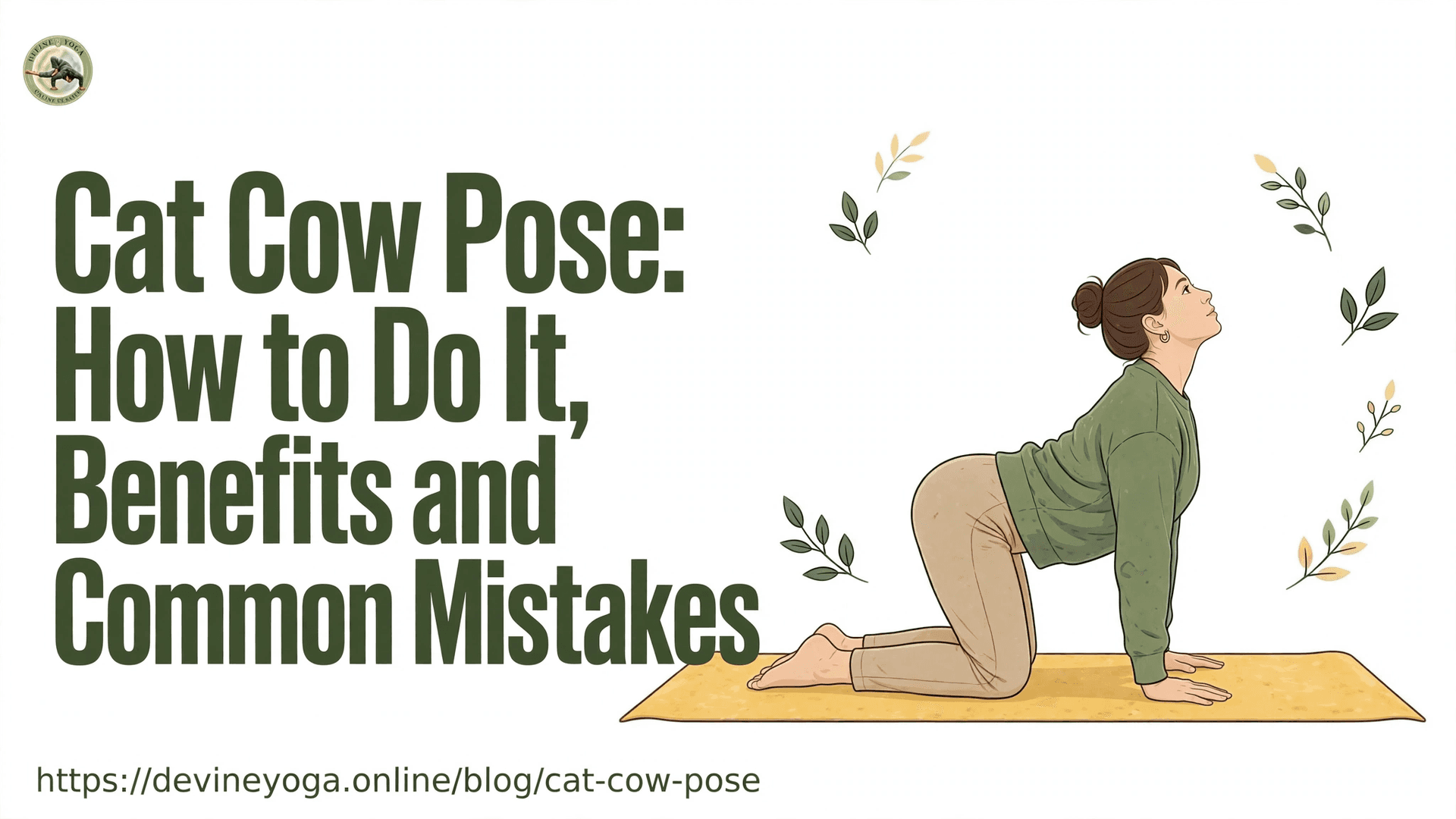
Cat Cow Pose: How to Do It, Benefits and Common Mistakes
Learn Cat Cow Pose step by step, its benefits, correct breathing, beginner modifications and common mistakes.

Summarize this blog with:
Cat Cow Pose is one of the simplest yoga movements for gently mobilising the spine and connecting breathing with physical movement. Whether you are new to yoga or have been practising for years, this gentle sequence can be a useful part of your daily routine.
Also known as Marjaryasana-Bitilasana, Cat Cow Pose combines two complementary movements: rounding the back like a stretching cat and gently arching it like a cow. It is commonly practised at the beginning of a yoga session to prepare the spine, shoulders and hips for further movement.
You do not need advanced flexibility or strength to practise it. What matters most is moving slowly, breathing naturally and respecting your body's comfortable range of motion.
In this guide, you will learn how to do Cat Cow Pose correctly, understand its physical and mental benefits, explore beginner-friendly modifications and avoid common mistakes that can affect your practice.
What Is Cat Cow Pose?
Cat Cow Pose is a gentle yoga movement in which you alternate between rounding and extending your spine while coordinating each movement with your breathing.
In Sanskrit, Marjari = cat, Bitila = cow, Asana = seat/pose.
Unlike a static hold like Tadasana, Cat Cow is dynamic vinyasa - movement matched to breath. You inhale into Cow and exhale into Cat. This is why it is different from just stretching your back. It trains three things together: spinal mobility, breath awareness, and mind-body coordination.
Cat Cow Pose is commonly used as a warm-up because it introduces controlled movement without requiring complicated postures or advanced flexibility.
In practice, beginners often find it looks easy but feels surprisingly deep once breathing is added. It is the foundation for Sun Salutations, and almost every traditional class in India starts with it to wake up the spine before deeper asanas.
Why Are Cat and Cow Practised Together?
Cat and Cow are complementary movements.
During Cat Pose, the spine moves into flexion, meaning the back rounds. During Cow Pose, the spine moves into extension, meaning the back gently arches.
Moving between these positions allows you to explore two different directions of spinal movement.
For example, imagine sitting at your desk for several hours. Your back may remain in almost the same position while you look at a laptop screen. A few gentle Cat Cow movements can introduce movement into your spine and help you become more aware of your posture.
The goal is not to force the back into its maximum range. Instead, move comfortably and allow your breathing to guide the sequence.
How to Do Cat Cow Pose: Step-by-Step Instructions
Cat Cow Pose is beginner-friendly, but correct alignment is important. Moving carelessly or forcing your back into a deep arch can create unnecessary strain.
Follow these steps to practise it comfortably.
Step 1: Prepare Your Yoga Space
Choose a flat, stable surface and place a yoga mat underneath you.
If your knees feel uncomfortable on the floor, place a folded blanket or soft towel beneath them.
Wear comfortable clothing that allows your spine, hips and shoulders to move freely.
Step 2: Come into Tabletop Position
Start on your hands and knees.
Position your body as follows:
- Place your palms directly beneath your shoulders.
- Keep your knees approximately hip-width apart.
- Align your knees beneath your hips.
- Spread your fingers comfortably across the mat.
- Keep your elbows gently extended without locking them.
- Position your neck in line with your spine.
- Look towards the floor between your hands.
Your back should be in a comfortable neutral position rather than excessively rounded or arched.
This is your starting position.
Step 3: Move into Cow Pose (Bitilasana)
Inhale slowly.
As you breathe in:
- Gently tilt your pelvis and lift your tailbone.
- Allow your abdomen to move towards the floor.
- Open your chest without forcing your shoulders.
- Draw your shoulder blades gently towards each other.
- Allow your gaze to move slightly forward.
Keep your neck long. Avoid throwing your head backwards or compressing the back of your neck.
Your spine should form a gentle curve rather than an exaggerated lower-back arch.
Step 4: Move into Cat Pose (Marjaryasana)
Exhale slowly.
As you breathe out:
- Gently tuck your tailbone underneath.
- Round your spine towards the ceiling.
- Draw your abdomen inward.
- Allow your shoulder blades to move apart.
- Bring your chin gently towards your chest.
- Direct your gaze towards your navel or the floor.
Imagine creating a smooth upward curve through your entire back.
Do not push your shoulders or neck aggressively. The movement should feel controlled and comfortable.
Step 5: Return to Cow Pose
As you begin your next inhalation, slowly move your pelvis and spine back into Cow Pose.
Open your chest and allow your abdomen to lower gently.
Keep the movement connected to your breath instead of rushing between positions.
Step 6: Repeat the Movement
Continue alternating between Cat and Cow.
For beginners:
- Start with 5 repetitions.
- Gradually increase to 8–10 repetitions if comfortable.
- Take one slow breath for each movement.
- Maintain a steady and relaxed rhythm.
After completing the sequence, return to a neutral Tabletop Position.
You can then sit back towards Child's Pose or move into another gentle yoga posture.
Quick Practice Summary
| Movement | Breathing | Spinal action |
|---|---|---|
| Cow Pose | Inhale | Gently extend the spine |
| Cat Pose | Exhale | Gently flex the spine |
| Neutral position | Natural breathing | Relax the spine |
Beginner tip: Do not worry about making a large arch or deep curve. A small, controlled movement performed with awareness is more useful than forcing a dramatic posture.
Benefits of Cat Cow Pose
Cat Cow Pose is a gentle movement, but it can offer several practical benefits when included in a regular yoga routine.
Its main value comes from combining spinal movement, muscular coordination and controlled breathing. For a broader overview of what research says about yoga's benefits and safety, see the NCCIH guide to yoga effectiveness and safety.
Let's understand its benefits in detail.
1. Improves Spinal Mobility
One of the main benefits of Cat Cow Pose is that it moves the spine through gentle flexion and extension.
Many everyday activities involve staying in relatively fixed positions. Sitting at a desk, driving, using a mobile phone or standing for extended periods can reduce the variety of movements we perform throughout the day.
Cat Cow introduces movement in both directions.
During Cat Pose, the back rounds. During Cow Pose, it gently arches.
Regular comfortable movement can help maintain awareness of spinal mobility and reduce the feeling of stiffness associated with remaining in one position.
However, Cat Cow is not a treatment for spinal disorders, and practising it does not guarantee increased flexibility for everyone.
2. Helps Reduce Everyday Back Stiffness
Some people experience a feeling of tightness in their back after spending long hours sitting or working.
Cat Cow provides a simple opportunity to move the back gently without immediately performing demanding stretches.
For example, someone who works on a laptop for six to eight hours may include a few rounds of Cat Cow during a movement break.
The slow movement can help the person become aware of areas that feel restricted and gradually explore comfortable movement.
It should not be used to push through sharp pain or unexplained back discomfort.
3. Encourages Better Postural Awareness
Posture is not simply about keeping your back straight all day.
It also involves understanding how your body moves and recognising when you remain in one position for too long.
Cat Cow helps you notice changes in your pelvis, abdomen, chest, shoulders and spine.
During practice, you learn to identify the difference between rounding your back and gently extending it.
This awareness can be useful when performing other yoga postures and everyday movements.
4. Gently Activates the Core Muscles
Cat Cow is not a replacement for strength training, but the movement involves gentle engagement of muscles around your abdomen and trunk.
During Cat Pose, you draw the abdomen inward while rounding your spine.
During Cow Pose, you coordinate the movement of your pelvis and trunk while maintaining control.
These actions encourage coordination between the abdominal muscles and the muscles that support your spine.
For beginners, this is a useful introduction to controlled trunk movement.
5. Stretches the Back and Front of the Torso
Cat and Cow create different sensations across the body.
In Cat Pose, the back of the torso lengthens as the spine rounds.
In Cow Pose, the chest opens and the front of the torso moves into a gentle stretch.
The combination introduces movement across the front and back of your trunk.
This can be particularly useful as preparation before a longer yoga session.
6. Improves Coordination Between Breathing and Movement
One important feature of Cat Cow is its breathing pattern.
You generally inhale while moving into Cow Pose and exhale while moving into Cat Pose.
This gives your attention a simple task: notice your breathing and coordinate your body with it.
Instead of performing movements mechanically, you begin to practise with greater awareness.
This connection between breathing and movement is an important part of many yoga practices.
7. Encourages Relaxation and Mindfulness
Cat Cow can also become a short mindfulness practice.
When you move slowly and pay attention to your breathing, you may become less distracted by surrounding activities.
The repeated movement creates a predictable rhythm that can help you settle into your yoga session.
It is not a guaranteed treatment for anxiety or stress, but it can be a useful part of a broader relaxation routine.
8. Prepares the Body for Other Yoga Postures
Cat Cow is frequently used near the beginning of a yoga session.
It introduces movement into the spine, shoulders and pelvis before practitioners move into other postures.
For example, it can be included before:
- Adho Mukha Svanasana (Downward-Facing Dog).
- Balasana (Child's Pose).
- Marjaryasana variations.
- Gentle seated twists.
- Other beginner-friendly Hatha Yoga movements.
This makes it a practical warm-up for many general yoga routines.
Common Mistakes in Cat Cow Pose and How to Avoid Them
Although Cat Cow is considered beginner-friendly, people often make small alignment mistakes that reduce comfort and control.
Here are some common mistakes and ways to correct them.
1. Moving Too Quickly
The mistake: Switching rapidly between Cat and Cow without coordinating the movements with breathing.
Why it matters: Fast movements can reduce body awareness and make it harder to control your spine.
How to correct it: Slow down. Complete one movement with each comfortable breath. Allow the transition to feel smooth.
2. Overarching the Lower Back
The mistake: Pushing the stomach excessively towards the floor during Cow Pose.
Why it matters: An exaggerated arch may place unnecessary pressure on the lower back.
How to correct it: Lift the chest gently and distribute the movement through the spine. Keep your abdomen lightly engaged.
3. Dropping the Head Too Far Back
The mistake: Looking directly towards the ceiling and compressing the back of the neck.
Why it matters: Excessive neck extension may create discomfort, especially for people with neck sensitivity.
How to correct it: Keep your neck long and look slightly forward or maintain a neutral gaze.
4. Rounding Only the Upper Back
The mistake: Performing Cat Pose by moving only the shoulders while leaving the rest of the spine relatively still.
Why it matters: The movement becomes concentrated in one area rather than distributed comfortably through the spine.
How to correct it: Begin with a gentle pelvic tuck and allow the movement to travel through the back gradually.
5. Placing the Hands Incorrectly
The mistake: Keeping the hands too far forward, too far backwards or excessively close together.
Why it matters: Poor positioning can make it difficult to distribute body weight evenly.
How to correct it: Keep your wrists approximately beneath your shoulders and spread your fingers comfortably.
6. Locking the Elbows
The mistake: Pushing the elbows into a rigid, locked position.
Why it matters: Excessive joint locking can create unnecessary tension through the arms and shoulders.
How to correct it: Keep your arms supportive but not rigid. Maintain a small amount of softness around the elbows.
7. Putting Too Much Weight on the Wrists
The mistake: Allowing all the upper-body weight to collapse into the wrists.
Why it matters: This may increase discomfort, especially for people with sensitive wrists.
How to correct it: Spread your fingers, press through the palms comfortably and distribute weight across both hands. Use fists, a chair or another supported variation if needed.
8. Holding Your Breath
The mistake: Concentrating so much on the shape of the posture that you forget to breathe.
Why it matters: The breathing rhythm is an important part of this movement.
How to correct it: Use the inhalation for Cow and the exhalation for Cat. If coordination becomes difficult, breathe naturally.
9. Forcing the Movement
The mistake: Trying to create the deepest possible arch or round in the back.
Why it matters: Greater movement does not automatically mean better movement.
How to correct it: Stay within a comfortable range. Your movement may be smaller than someone else's, and that is perfectly acceptable.
For more beginner guidance, see our guide to common yoga mistakes beginners make.
Best Time to Practise Cat Cow Pose
Cat Cow can be practised at different times of the day. There is no scientifically established best time that makes the posture more effective for everyone.
The right time depends on your daily schedule and personal comfort. If you are planning a broader routine, our guide to the best time to do yoga, morning or evening may also help.
1. In the Morning
Morning practice can be useful when your back feels stiff after sleeping.
A few gentle rounds can introduce movement before you continue with your regular yoga routine.
Start slowly, especially if your body feels stiff immediately after waking.
2. Before a Yoga Session
This is one of the most common ways to use Cat Cow.
Practising it at the beginning of a yoga session introduces controlled movement before more demanding postures.
You can combine it with gentle shoulder movements and other warm-up exercises.
3. During Office Breaks
People who spend long hours sitting may find seated Cat Cow useful.
Try a few gentle repetitions during a short break instead of remaining in the same position throughout the day.
Remember to stand up, walk and change positions as well. One exercise cannot replace regular movement.
4. In the Evening
You can also include Cat Cow in a gentle evening stretching routine.
Move slowly and comfortably, using natural breathing to settle your attention.
Avoid turning the exercise into an intense backbend session immediately before bed.
Cat Cow for Desk Workers
If you spend most of your day working on a computer, consider including a short movement break.
For example:
- Take a break after a prolonged period of sitting.
- Stand and walk briefly.
- Practise five to eight seated Cat Cow repetitions.
- Relax your shoulders.
- Return to work with a comfortable posture.
You can also include a few rounds of traditional Cat Cow during your morning yoga practice.
The purpose is to introduce movement into a routine that may otherwise involve prolonged sitting.
Conclusion
Cat Cow Pose is a simple yet valuable movement that can become part of almost any beginner-friendly yoga routine.
By combining Marjaryasana and Bitilasana, you gently move your spine through flexion and extension while developing awareness of your breathing, posture and body movement.
Its main benefits include supporting spinal mobility, encouraging controlled movement, preparing the body for other yoga postures and helping you develop a more mindful connection between breathing and movement.
You do not need advanced flexibility, expensive equipment or a complicated routine to begin. Start with five slow repetitions, maintain comfortable alignment and gradually develop consistency.
At Devine Yoga Online, we encourage beginners to approach yoga with patience and awareness rather than focusing only on achieving perfect postures.
If you spend long hours sitting, feel occasional stiffness or simply want to begin your yoga journey with a gentle movement, Cat Cow can be a useful addition to your routine.
Start slowly, breathe naturally and allow your body to move at its own pace.
Frequently asked questions
What is Cat Cow Pose in yoga?
Cat Cow Pose is a gentle yoga movement that combines Cat Pose (Marjaryasana) and Cow Pose (Bitilasana). It is performed by alternately rounding and extending the spine while coordinating the movements with breathing. It is commonly used as a warm-up and spinal-mobility exercise.
What are the main benefits of Cat Cow Pose?
Cat Cow can help improve awareness of spinal movement, gently mobilise the back, coordinate breathing with movement and prepare the body for other yoga postures. It also encourages controlled movement of the shoulders and pelvis. Its benefits depend on individual comfort and consistent practice.
Is Cat Cow good for back pain?
Many people with mild stiffness find it comforting, and research shows yoga in general can help chronic low back pain. However, no study proves Cat Cow alone works. If you have significant or persistent pain, see a doctor or physiotherapist before starting.
What is the difference between Cat Cow and Cat Camel?
They are essentially the same movement. "Cat camel" is the term often used in physiotherapy and Pilates, while "Cat Cow" is the yoga name. Both describe alternating between rounding and arching the spine on hands and knees.
Reading is a start. A live teacher is the shortcut.
In a Devine Yoga Online class your trainer sees you, corrects you by name and adapts every pose to your body - beginners included.
Related blogs
What Is Aerial Yoga? Meaning, Benefits, and Basics
What is aerial yoga? Learn its meaning, how aerial hammock yoga works, benefits, safety tips, basics for beginners & who should avoid it.
12 min read
Yoga for Senior Citizens: Benefits, Easy Poses and Safety Tips
Explore gentle yoga for senior citizens, including chair yoga, beginner-friendly poses, benefits, safety tips and a simple daily routine for healthy ageing.
18 min read
What Is Ashtanga Yoga? A Complete Beginner’s Guide
What is Ashtanga Yoga? Learn history, 8 limbs, Primary Series, science-backed benefits and how to start this powerful practice safely today.
9 min read