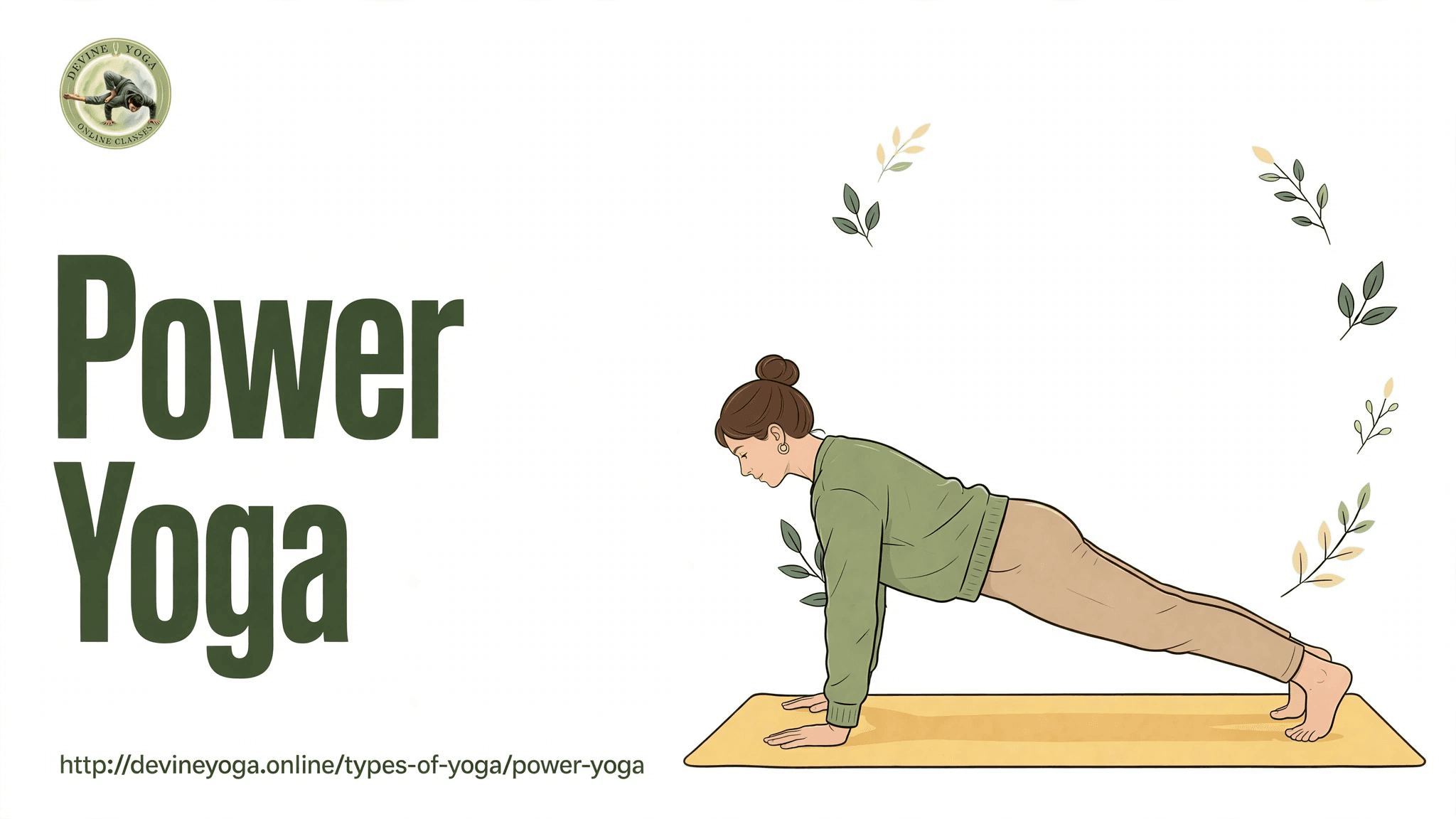
Power Yoga
Power yoga is a fast, strength-focused style that grew from Ashtanga. Learn the benefits, a 15-minute beginner flow, common mistakes and who should be careful.
Summarize this blog with:
What is power yoga?
Power yoga is an athletic style of vinyasa yoga. You move quickly between poses, hold challenging ones like chair, warrior and plank, and repeat flows that raise your heart rate. The emphasis is on strength, endurance and sweat, rather than on tradition, chanting or slow relaxation.
“Power yoga” is a general term, not a trademarked method. What you get depends on the teacher and studio, so one class might be close to Ashtanga and another closer to a bodyweight workout.
Where does it come from?
The term “power yoga” came into use in the United States in the 1990s. Two teachers are usually credited with popularizing it: Beryl Bender Birch, who adapted the Ashtanga method she learned from K. Pattabhi Jois, and Bryan Kest, who began teaching a style he called “power yoga” in Santa Monica, California. It spread widely through gyms and fitness studios.
It is a modern Western development of Ashtanga, so it’s best described as “inspired by” Indian yoga traditions rather than as an ancient practice.
What happens in a class?
A typical 45 to 60 minute class includes:
- Warm-up: gentle movement and breath awareness
- Sun salutations: several fast rounds to build heat
- Strength flows: standing poses, lunges, planks and chaturangas
- Core work: boat pose, plank variations and similar
- Balance and hip work: such as warrior III, pigeon or lizard
- Cool-down and Savasana: stretching and a final rest
Music is common, and many teachers focus more on effort and alignment than on spiritual themes.
Benefits
- Strength: Holding poses and repeating chaturangas works the legs, core, arms and shoulders.
- Stamina: The fast pace raises your heart rate and builds endurance.
- Flexibility: Dynamic stretching improves range of motion over time.
- Focus: A demanding class leaves little room for wandering thoughts.
- Calorie burn: It is an active workout, though the amount varies widely by person and class.
- Stress relief: Many people feel a “reset” after hard exercise combined with breath awareness.
Research on yoga overall suggests modest benefits for stress, wellbeing and low back pain, and some studies show that more vigorous yoga can improve fitness measures. Studies on power yoga specifically are limited, and results vary. It is not a medical treatment.
Is power yoga good for beginners?
It can be, in a beginner-level class with a teacher who offers modifications. Power yoga moves fast and asks for upper body strength, so a full class can be a lot if you’re new to exercise.
It may suit you if you:
- Want a strong, sweaty workout
- Already exercise or have a baseline of fitness
- Get bored in slow, hold-based classes
- Like variety from class to class
Another style may suit you better if you:
- Are very stiff, deconditioned or recovering from an injury (try Hatha or Iyengar)
- Mainly want relaxation or stress relief (try Restorative or Yin)
- Prefer a spiritual or meditative focus (try Kundalini or Hatha)
A simple beginner power flow
This takes about 15 minutes. Breathe through your nose, and keep your knees bent where needed.
- Mountain pose (Tadasana): 5 breaths
- Sun Salutation A (Surya Namaskara A): 3 slow rounds, stepping back instead of jumping
- Chair pose (Utkatasana): 5 breaths, weight in your heels
- Warrior II (Virabhadrasana II): 5 breaths, both sides
- Plank (Phalakasana): hold for 5 breaths, with knees down if needed
- Boat pose (Navasana), modified: knees bent, 5 breaths
- Bridge (Setu Bandhasana): 3 rounds of 5 breaths
- Child’s pose (Balasana): rest for 5 breaths
- Savasana: 3 to 5 minutes
Learn it in a live class if you can, so a teacher can check your alignment.
Common mistakes
- Rushing and losing form. Speed is not the goal. Slow down if your alignment slips.
- Dumping weight into the wrists and shoulders. Lower your knees in plank and chaturanga when tired.
- Jumping too early. Skip jump-backs until your shoulders and wrists are strong.
- Holding the breath. If your breath turns ragged, you’re pushing too hard.
- Skipping the warm-up and cool-down.
- Ignoring pain. Muscle effort is normal, but sharp joint pain is a stop signal.
- Practicing every day with no rest. Your body needs recovery days.
Who should be careful?
Talk to your doctor and tell your teacher first if you:
- Are pregnant or recently gave birth
- Have wrist, shoulder, knee, hip or spine injuries, or recent surgery
- Have high blood pressure, a heart condition or a breathing problem
- Have osteoporosis or hypermobile joints
- Have dizziness, balance problems or glaucoma
- Are new to exercise after a long break
Stop and rest if you feel dizzy, breathless, nauseated or sharp pain.
Medical disclaimer: This article is for general education and is not medical advice. Consult a qualified healthcare professional before starting a vigorous yoga practice, especially if you have a health condition.
Power yoga vs similar styles
| Power | Ashtanga | Vinyasa | Hatha | |
|---|---|---|---|---|
| Sequence | Varies each class | Fixed | Varies | Varies, often basic |
| Pace | Fast | Fast | Moderate to fast | Slow |
| Focus | Strength and fitness | Discipline, breath, tradition | Flowing movement | General basics |
| Spiritual elements | Usually light | Moderate (chant, drishti) | Light to moderate | Optional |
| Best for | Fitness-minded students | Disciplined, active students | People who like variety | Beginners |
Frequently asked questions
What is power yoga in simple words?
A fast, strength-focused style of yoga where you link poses in a flowing sequence that raises your heart rate. It grew out of Ashtanga but has no fixed sequence.
Is power yoga good for beginners?
It can be in a beginner-level class with modifications. If you’re very stiff, injured or want relaxation, start with Hatha, Iyengar or Restorative.
Is power yoga good for weight loss?
It is an active workout that burns calories, but weight loss depends on your overall diet and activity. Yoga alone is not a guaranteed method.
What is the difference between power yoga and Ashtanga?
Ashtanga follows the same fixed sequence every class, while power yoga varies. Power yoga is also usually less traditional and more fitness-focused.
How often should I practice?
Two to three sessions a week of 30 to 60 minutes is a good start, with rest days in between.
Can I do power yoga online?
Yes, in a live class where the teacher can see you, especially while you’re learning. Beginners should avoid following fast videos without feedback.
Try Power Yoga live. Your first 3 days are free.
Join a live Devine Yoga Online class: a real trainer watches you over video, corrects your poses by name and adapts every move to your body, beginners included.
More types of yoga
Ashtanga Yoga
Ashtanga yoga is a style in which you move through a set series of poses in a fixed order.
Explore More
Face Yoga
Face yoga combines facial exercises, gentle self-massage, breathing and relaxation.
Explore More
Flow Yoga
Flow yoga, also called vinyasa flow, is a style in which poses are linked together in a continuous sequence.
Explore More