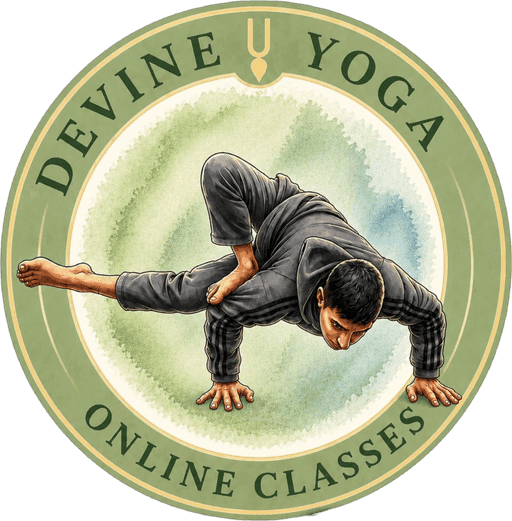
Flow Yoga
Discover flow yoga, also called vinyasa flow. See what happens in class, the benefits, a 15-minute beginner flow and how it compares with other styles.
Summarize this blog with:
What is flow yoga?
Flow yoga, also called vinyasa flow, is a style in which poses are linked together in a continuous sequence. Instead of holding each pose for a long time, you move with your breath: breathe in as you lift or open, breathe out as you fold or twist.
The Sanskrit word vinyasa is often explained as “to place in a special way,” meaning poses are arranged in a thoughtful order. In practice, “flow yoga” and “vinyasa yoga” are used almost interchangeably, though some studios use “flow” for a gentler, more creative class.
Where does it come from?
Flow yoga grew out of the dynamic, breath-linked teaching of T. Krishnamacharya in India in the early 20th century. His students, including K. Pattabhi Jois (Ashtanga yoga), helped spread the method, and it became popular in the West from the 1980s onward. Modern flow classes are usually shaped by each teacher’s own training, so no two classes are exactly the same.
What happens in a flow class?
A typical 45 to 60 minute class includes:
- Centering: a few minutes of breath awareness
- Warm-up: gentle movements like cat-cow and neck rolls
- Sun salutations: the classic flowing sequence that warms the body
- Standing flow: poses such as warrior, triangle and lunges
- Floor poses: hip openers, twists and forward folds
- Cool-down and Savasana: final relaxation
The music, pace and theme change from class to class, which many students enjoy.
What are the benefits?
Flow yoga may help with:
- Strength: Moving through poses works your legs, core, arms and shoulders.
- Flexibility: Gradual, repeated movement improves your range of motion.
- Stamina: The steady pace raises your heart rate, more than a slow hold-based class.
- Focus: Matching movement to breath gives your mind one thing to follow.
- Stress relief: Rhythmic movement with slow breathing helps many people feel calmer.
- Mobility for desk workers: Spine, hip and shoulder movement can ease stiffness from sitting.
- Variety: Changing sequences keep practice interesting, which helps you stay consistent.
Research on yoga overall suggests modest benefits for stress, wellbeing and low back pain. Studies on flow yoga specifically are limited, and results vary from person to person. Flow yoga is exercise and mindfulness practice, not a medical treatment.
Is flow yoga good for beginners?
Yes, if you choose a beginner-level class. Flow can feel fast at first, so look for a class that explains poses and offers modifications.
It may suit you if you:
- Like moving rather than holding still
- Want a good mix of strength and flexibility
- Get bored with repetitive routines
- Want a workout that also calms the mind
Another style may suit you better if you:
- Are very stiff or recovering from an injury (try Hatha, Iyengar or Restorative)
- Mainly want slow relaxation (try Yin or Restorative)
- Prefer a fixed routine (try Ashtanga)
A simple 15-minute beginner flow
Move slowly and breathe through your nose. Take 5 breaths in each pose unless told otherwise.
- Mountain pose (Tadasana): stand tall, feet hip-width apart
- Cat-cow: on hands and knees, 8 slow rounds
- Downward dog (Adho Mukha Svanasana): bend your knees if your back rounds
- Low lunge (Anjaneyasana): step one foot forward, both sides
- Warrior II (Virabhadrasana II): both sides
- Triangle (Trikonasana): both sides, with a block if needed
- Child’s pose (Balasana): rest for 5 breaths
- Seated twist (Ardha Matsyendrasana): both sides, gently
- Savasana: rest for 3 to 5 minutes
Common mistakes
- Moving too fast. If you can’t breathe smoothly, slow down.
- Skipping the warm-up. Cold muscles are more likely to strain.
- Locking knees and elbows. Keep a soft bend in the joints.
- Dropping into poses. Move with control, especially in plank and low push-ups.
- Skipping rest. Take Child’s pose whenever you need it.
- Comparing yourself to others. Everyone’s range and pace are different.
Who should be careful?
Talk to your doctor and tell your teacher first if you:
- Are pregnant or recently gave birth
- Have wrist, shoulder, knee, hip or spine injuries, or recent surgery
- Have high blood pressure, a heart condition or a breathing problem
- Have osteoporosis or severe joint hypermobility
- Have dizziness, balance problems or glaucoma
Stop and rest if you feel dizzy, breathless or sharp pain.
Medical disclaimer: This article is for general education and is not medical advice. Consult a qualified healthcare professional before starting yoga, especially if you have a health condition.
How does it compare with other styles?
| Flow | Hatha | Ashtanga | Yin | |
|---|---|---|---|---|
| Pace | Moderate, continuous | Slow | Fast | Very slow |
| Sequence | Varies each class | Varies, often basic | Fixed | Long holds |
| Intensity | Moderate to high | Low to moderate | High | Low |
| Best for | People who like movement | Beginners | Disciplined, active students | Flexibility and relaxation |
Frequently asked questions
Is flow yoga the same as vinyasa?
Mostly yes. Both link poses with breath. Some studios call a gentler or more creative class “flow,” but the terms overlap.
How often should I practice?
Two or three sessions a week of 30 to 45 minutes is a good start. Add days gradually.
Can flow yoga help with weight loss?
It is an active practice that supports fitness, but weight loss depends on your overall diet and activity. Yoga alone is not a guaranteed method.
Do I need to be flexible?
No. Flexibility develops with practice. Use blocks, bend your knees and go at your own pace.
Is it good for stress?
Many people find rhythmic movement with slow breathing calming. It can support stress management, but it isn’t a treatment for anxiety or other conditions.
Try Flow Yoga live. Your first 3 days are free.
Join a live Devine Yoga Online class: a real trainer watches you over video, corrects your poses by name and adapts every move to your body, beginners included.
More types of yoga
Ashtanga Yoga
Ashtanga yoga is a style in which you move through a set series of poses in a fixed order.
Explore More
Face Yoga
Face yoga combines facial exercises, gentle self-massage, breathing and relaxation.
Explore More
Prenatal Yoga
Prenatal yoga is a gentle practice designed around the changes of pregnancy: a growing belly, a shifting center of balance, looser joints and…
Explore More